
What this guide is for
Your institution launches a PPP program to build and run visitor centers, museums, conservation labs, digital records and heritage trails as public-private partnerships (PPPs), with conservation first.
The case
Heritage institutions guard what every visitor comes to see
Heritage sites and museums have long been funded by public budgets, grants and entry fees, and the visitor centers, labs and services around them have often been built one at a time. The heritage sites of the next fifty years will be documented, conserved and presented with partners who invest in them, and the institutions that set up those partnerships now will decide how conservation is funded for as long as the contracts last. This guide invites heritage and antiquities institutions in Jordan to launch a PPP program, starting with the projects at home.
The guide
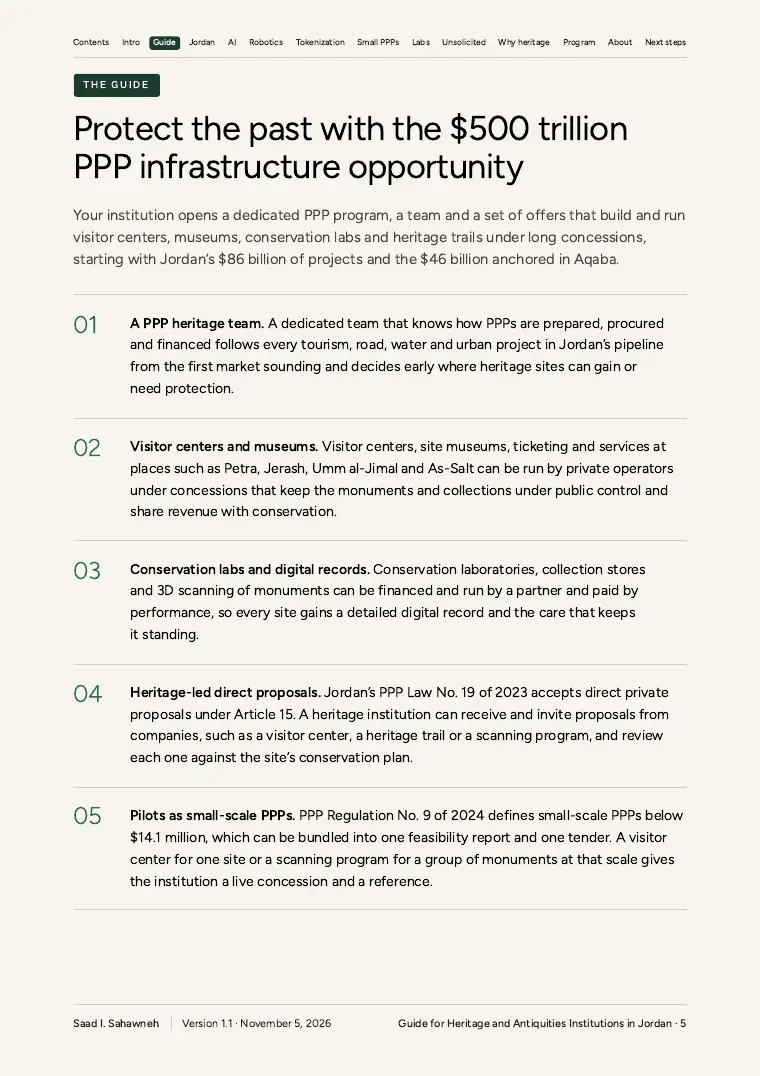
Protect the past with the $500 trillion PPP infrastructure opportunity
Your institution opens a dedicated PPP program, a team and a set of offers that build and run visitor centers, museums, conservation labs and heritage trails under long concessions, starting with Jordan’s $86 billion of projects and the $46 billion anchored in Aqaba.
01
A PPP heritage team
A dedicated team that knows how PPPs are prepared, procured and financed follows every tourism, road, water and urban project in Jordan’s pipeline from the first market sounding and decides early where heritage sites can gain or need protection.
02
Visitor centers and museums
Visitor centers, site museums, ticketing and services at places such as Petra, Jerash, Umm al-Jimal and As-Salt can be run by private operators under concessions that keep the monuments and collections under public control and share revenue with conservation.
03
Conservation labs and digital records
Conservation laboratories, collection stores and 3D scanning of monuments can be financed and run by a partner and paid by performance, so every site gains a detailed digital record and the care that keeps it standing.
04
Heritage-led direct proposals
Jordan’s PPP Law No. 19 of 2023 accepts direct private proposals under Article 15. A heritage institution can receive and invite proposals from companies, such as a visitor center, a heritage trail or a scanning program, and review each one against the site’s conservation plan.
05
Pilots as small-scale PPPs
PPP Regulation No. 9 of 2024 defines small-scale PPPs below $14.1 million, which can be bundled into one feasibility report and one tender. A visitor center for one site or a scanning program for a group of monuments at that scale gives the institution a live concession and a reference.
Why heritage and antiquities institutions
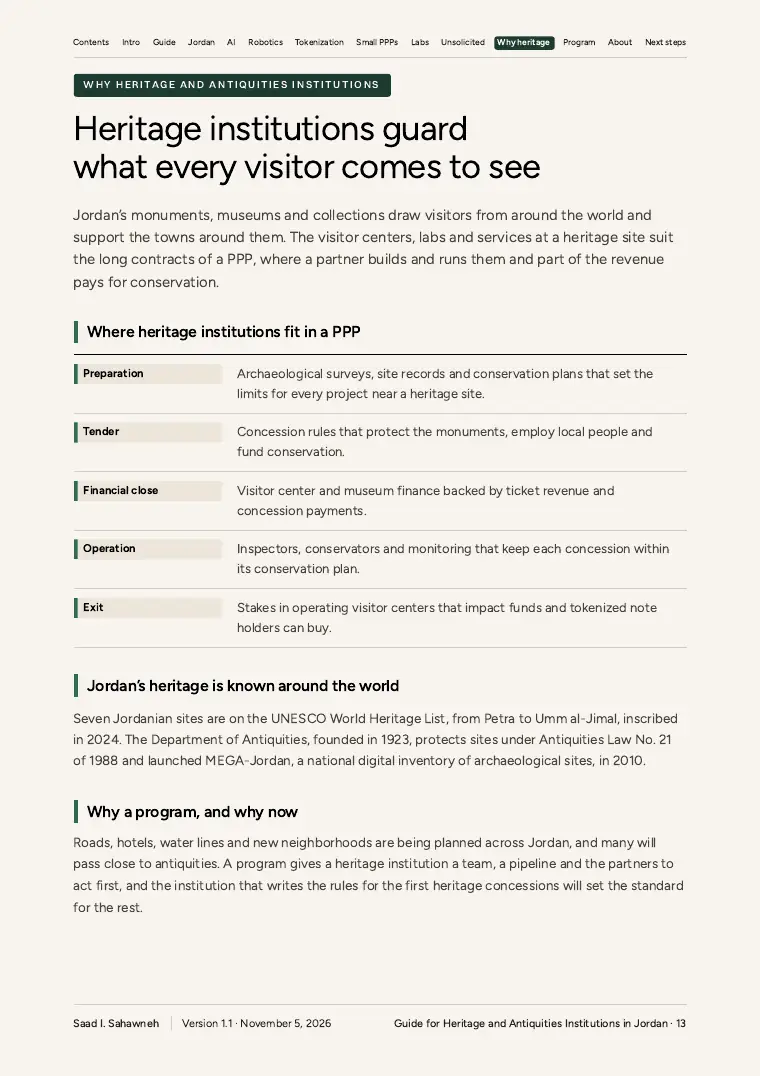
Heritage institutions guard what every visitor comes to see
Jordan’s monuments, museums and collections draw visitors from around the world and support the towns around them. The visitor centers, labs and services at a heritage site suit the long contracts of a PPP, where a partner builds and runs them and part of the revenue pays for conservation.
Where heritage institutions fit in a PPP
- Preparation
- Archaeological surveys, site records and conservation plans that set the limits for every project near a heritage site.
- Tender
- Concession rules that protect the monuments, employ local people and fund conservation.
- Financial close
- Visitor center and museum finance backed by ticket revenue and concession payments.
- Operation
- Inspectors, conservators and monitoring that keep each concession within its conservation plan.
- Exit
- Stakes in operating visitor centers that impact funds and tokenized note holders can buy.
Jordan’s heritage is known around the world
Seven Jordanian sites are on the UNESCO World Heritage List, from Petra to Umm al-Jimal, inscribed in 2024. The Department of Antiquities, founded in 1923, protects sites under Antiquities Law No. 21 of 1988 and launched MEGA-Jordan, a national digital inventory of archaeological sites, in 2010.
Why a program, and why now
Roads, hotels, water lines and new neighborhoods are being planned across Jordan, and many will pass close to antiquities. A program gives a heritage institution a team, a pipeline and the partners to act first, and the institution that writes the rules for the first heritage concessions will set the standard for the rest.

Futureproofing
Futureproof Heritage and Antiquities Institutions in Jordan for the infrastructure singularity
This free 17-page guide shows how, with small PPPs in parallel, PPP research labs, artificial intelligence, robotics, tokenization and six first steps.
Jordan and Aqaba
An $86 billion pipeline to start with
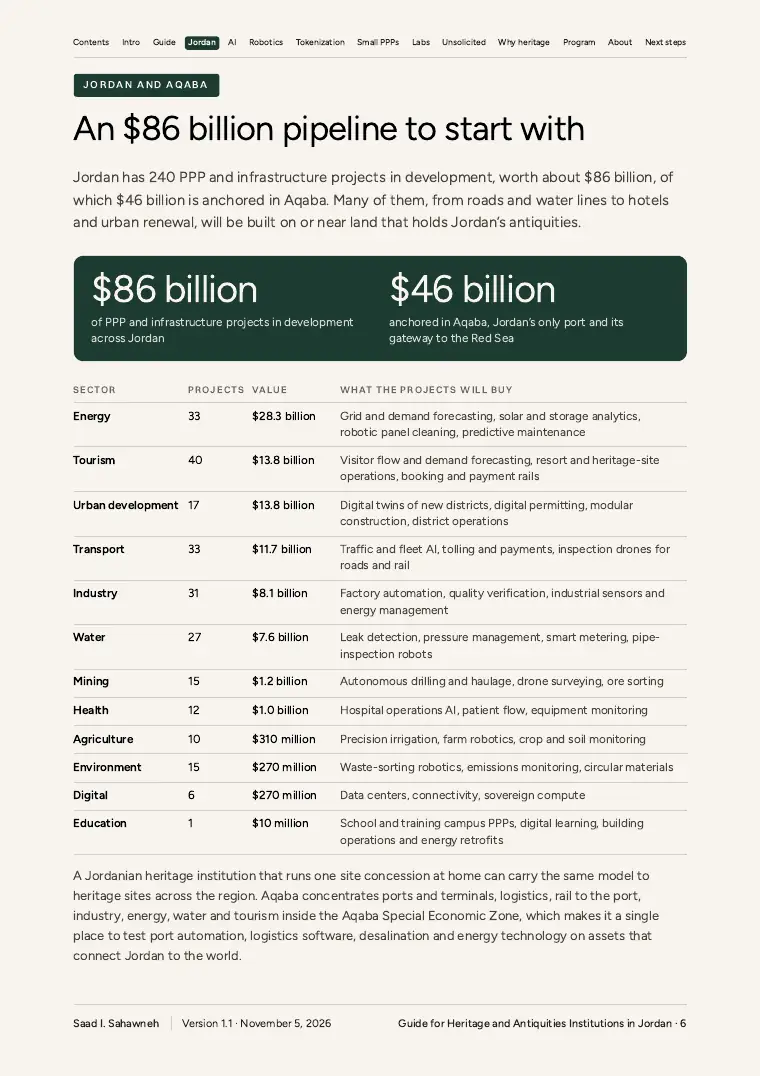
Many of them, from roads and water lines to hotels and urban renewal, will be built on or near land that holds Jordan’s antiquities. A Jordanian heritage institution that runs one site concession at home can carry the same model to heritage sites across the region.
- $86B
- of PPP and infrastructure projects in development in Jordan
- $46B
- of them anchored in Aqaba

Artificial intelligence
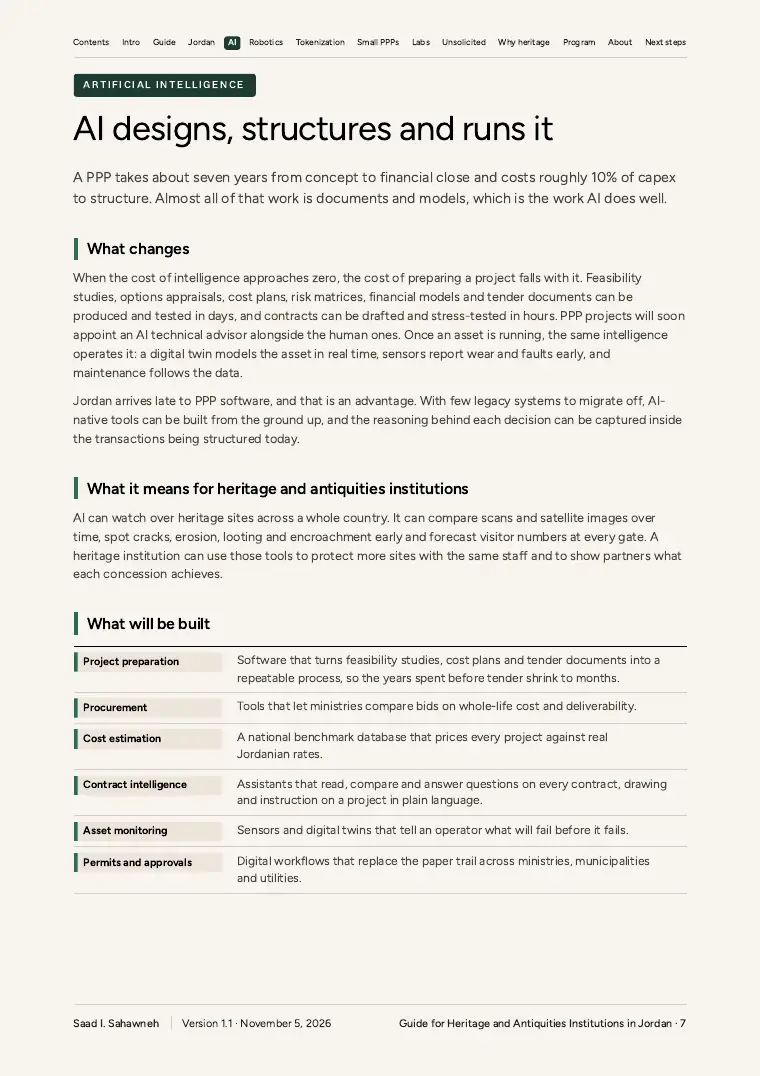
AI can watch over heritage sites across a whole country. It can compare scans and satellite images over time, spot cracks, erosion, looting and encroachment early and forecast visitor numbers at every gate. A heritage institution can use those tools to protect more sites with the same staff and to show partners what each concession achieves.

Robotics
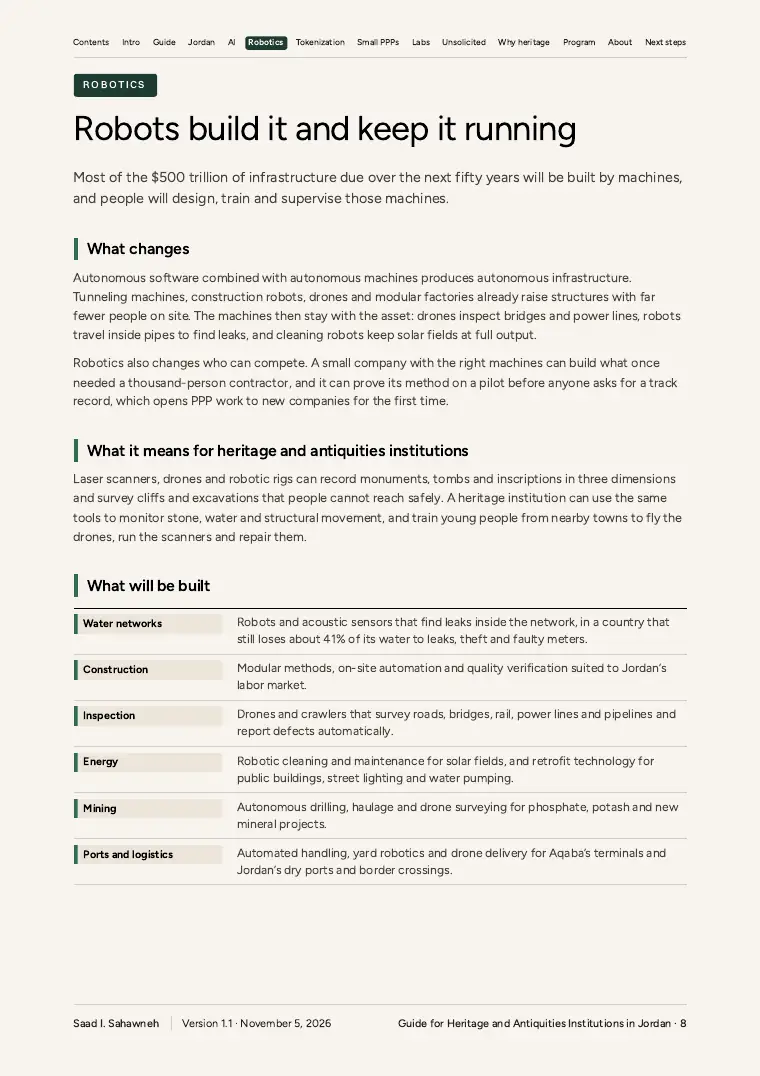
Laser scanners, drones and robotic rigs can record monuments, tombs and inscriptions in three dimensions and survey cliffs and excavations that people cannot reach safely. A heritage institution can use the same tools to monitor stone, water and structural movement, and train young people from nearby towns to fly, scan and repair them.

Tokenization
Tokenization can let visitors and investors fund the places they come to see. Stakes in a visitor center or a conservation program can be offered as tokenized notes, paid from ticket revenue and concession fees, and each token can record the monuments scanned and the conservation work completed.

Small PPPs and research labs
Small PPPs let a heritage institution prove a new model at one site at low cost. It can host a PPP research lab that trials 3D scanning, AI condition monitoring and digital guides, publish every result and carry the pilots that work to heritage sites across Jordan.

Unsolicited proposals
Direct proposals let companies bring a visitor center, a heritage trail or a scanning program to a site as their own project. A heritage institution can invite them, review each one against its conservation plan and keep the proposer’s right to match the best offer at tender.
The program
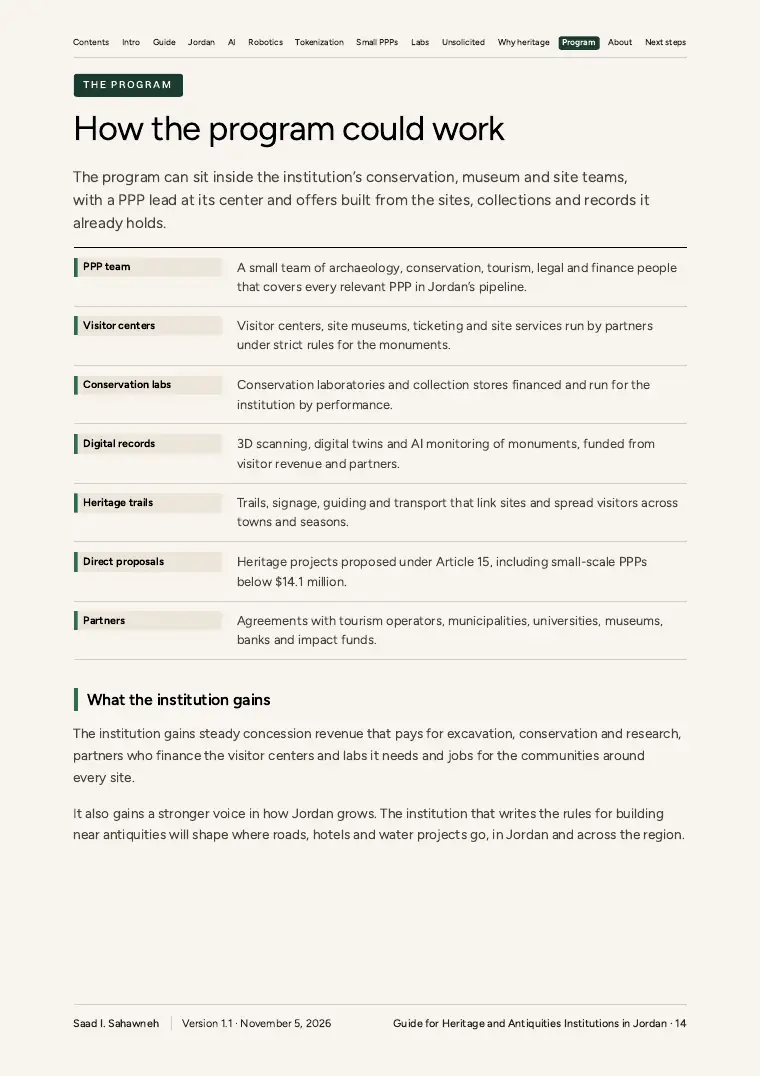
How the program could work
The program can sit inside the institution’s conservation, museum and site teams, with a PPP lead at its center and offers built from the sites, collections and records it already holds.
- PPP team
- A small team of archaeology, conservation, tourism, legal and finance people that covers every relevant PPP in Jordan’s pipeline.
- Visitor centers
- Visitor centers, site museums, ticketing and site services run by partners under strict rules for the monuments.
- Conservation labs
- Conservation laboratories and collection stores financed and run for the institution by performance.
- Digital records
- 3D scanning, digital twins and AI monitoring of monuments, funded from visitor revenue and partners.
- Heritage trails
- Trails, signage, guiding and transport that link sites and spread visitors across towns and seasons.
- Direct proposals
- Heritage projects proposed under Article 15, including small-scale PPPs below $14.1 million.
- Partners
- Agreements with tourism operators, municipalities, universities, museums, banks and impact funds.
What the institution gains
The institution gains steady concession revenue that pays for excavation, conservation and research, partners who finance the visitor centers and labs it needs and jobs for the communities around every site.
It also gains a stronger voice in how Jordan grows. The institution that writes the rules for building near antiquities will shape where roads, hotels and water projects go, in Jordan and across the region.

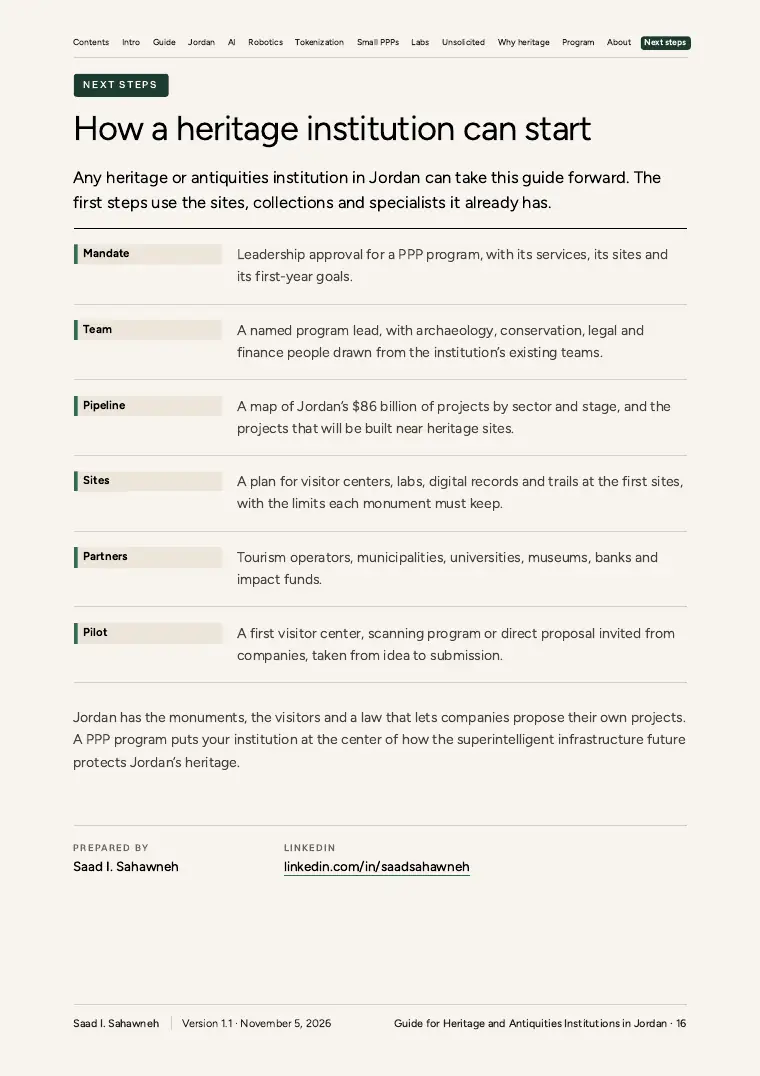
Next steps
How a heritage institution can start
Any heritage or antiquities institution in Jordan can take this guide forward. The first steps use the sites, collections and specialists it already has.
01
Mandate
Leadership approval for a PPP program, with its services, its sites and its first-year goals.
02
Team
A named program lead, with archaeology, conservation, legal and finance people drawn from the institution’s existing teams.
03
Pipeline
A map of Jordan’s $86 billion of projects by sector and stage, and the projects that will be built near heritage sites.
04
Sites
A plan for visitor centers, labs, digital records and trails at the first sites, with the limits each monument must keep.
05
Partners
Tourism operators, municipalities, universities, museums, banks and impact funds.
06
Pilot
A first visitor center, scanning program or direct proposal invited from companies, taken from idea to submission.
Jordan has the monuments, the visitors and a law that lets companies propose their own projects. A PPP program puts your institution at the center of how the superintelligent infrastructure future protects Jordan’s heritage.
The full document
Inside this guide
Seventeen pages and thirteen chapters, from the case for a PPP program to the first steps, written for heritage and antiquities institutions in Jordan.
- 17
- pages
- 13
- chapters
- 3
- technologies
- 6
- first steps
01Introduction
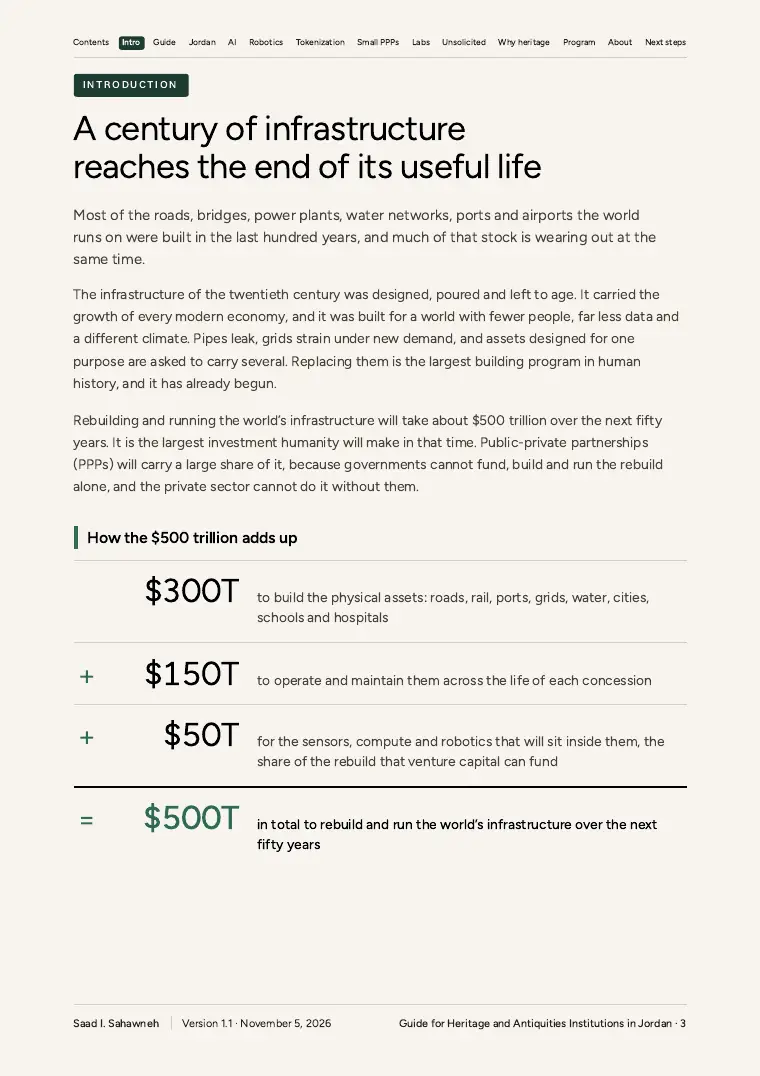
Why a century of infrastructure needs rebuilding, and the $500 trillion it will take.
Page 3 of 17
02The guide
Protect the past with the $500 trillion PPP infrastructure opportunity
Page 5 of 17
03Jordan and Aqaba
An $86 billion pipeline to start with
Page 6 of 17
04Artificial intelligence
How AI designs, structures and runs PPP projects, and what it means for heritage and antiquities institutions.
Page 7 of 17
05Robotics
How robots build infrastructure and keep it running, and what that means for heritage and antiquities institutions.
Page 8 of 17
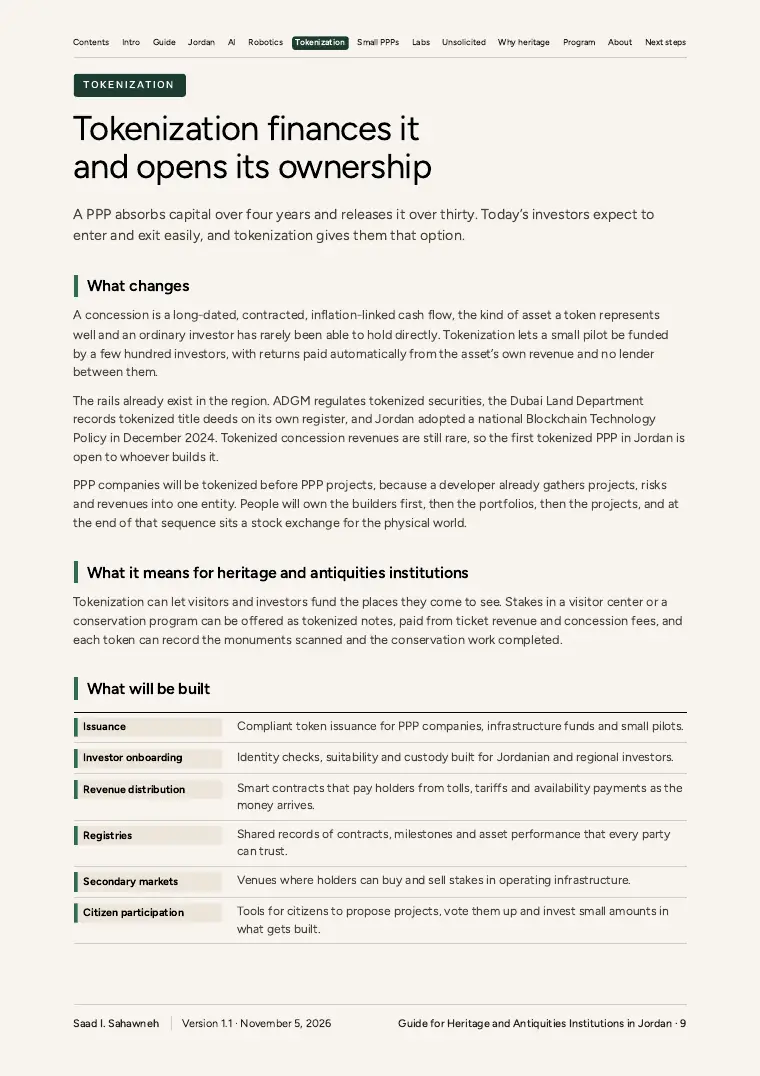
06Tokenization
How tokenization funds projects from their own revenue, and the role it opens for heritage and antiquities institutions.
Page 9 of 17
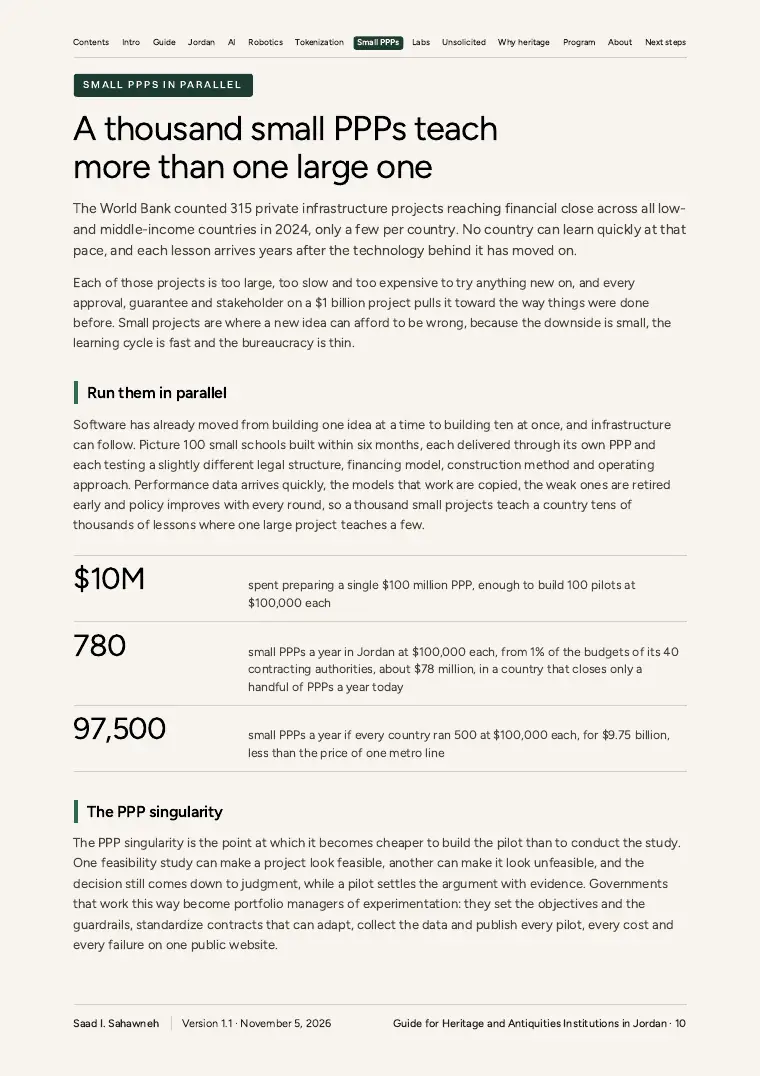
07Small PPPs in parallel
Why many small PPPs teach a country faster than a few large ones.
Page 10 of 17
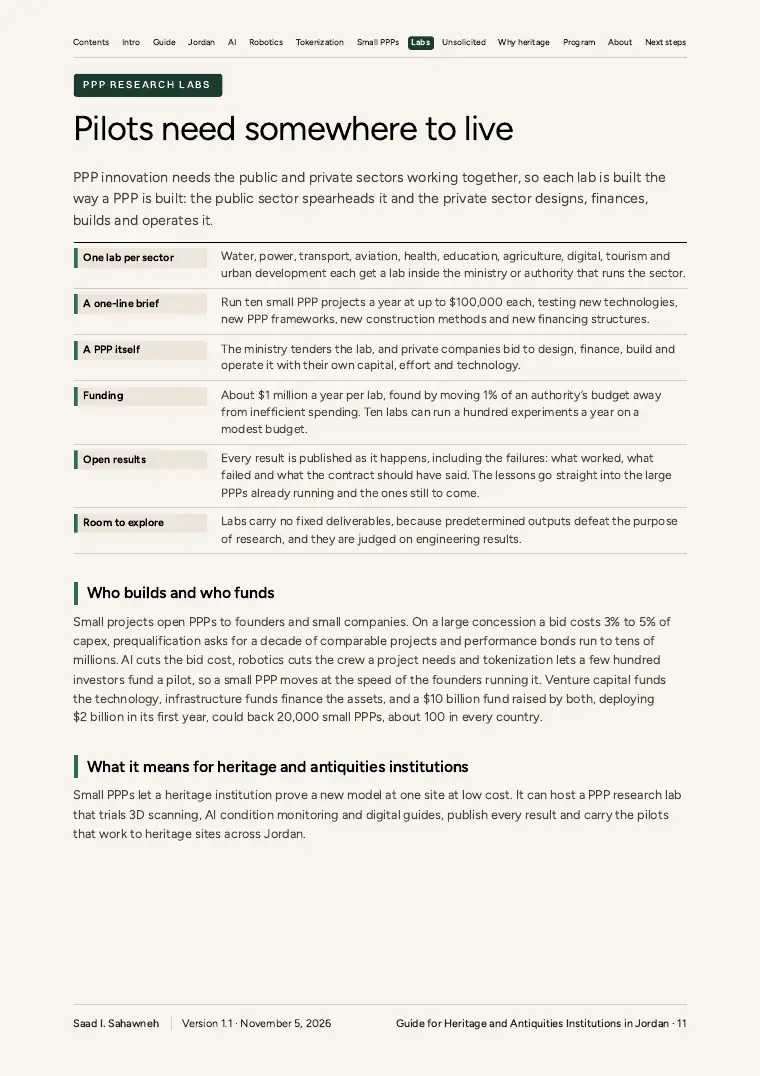
08PPP research labs
A lab in each sector, running ten small PPP projects a year.
Page 11 of 17
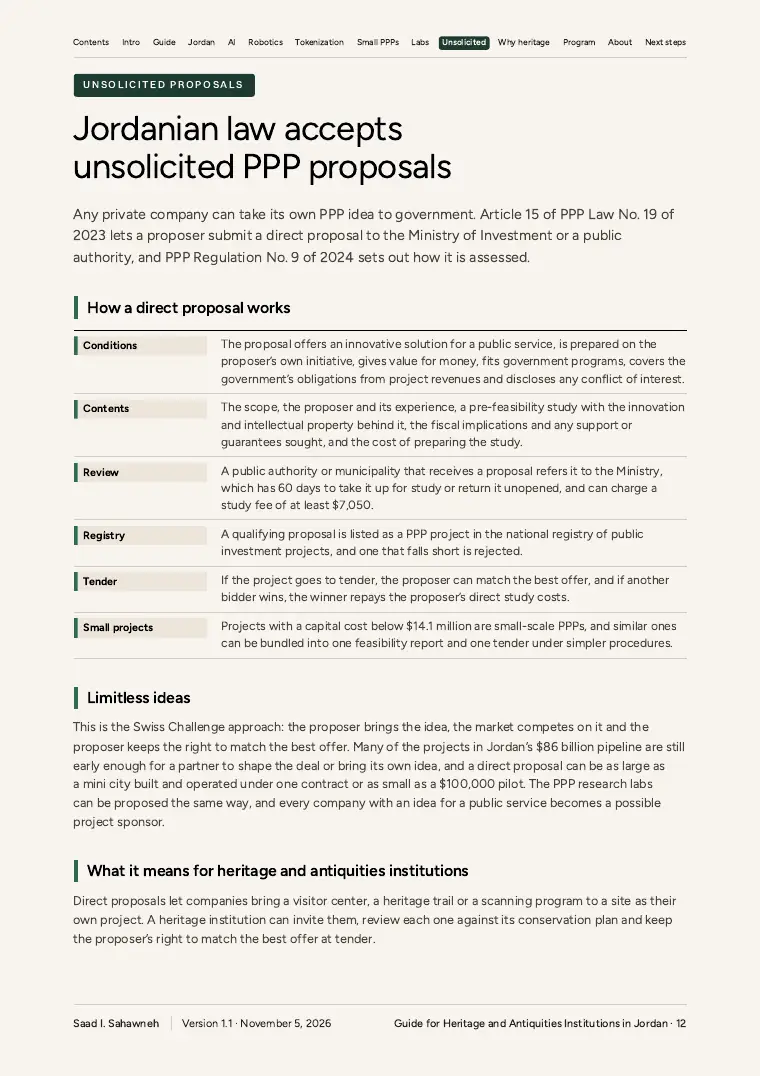
09Unsolicited proposals
How Jordan’s PPP law accepts direct proposals from private companies.
Page 12 of 17
10Why heritage and antiquities institutions
Heritage institutions guard what every visitor comes to see
Page 13 of 17
11The program
The program can sit inside the institution’s conservation, museum and site teams, with a PPP lead at its center and offers built from the sites, collections and records it already holds.
Page 14 of 17
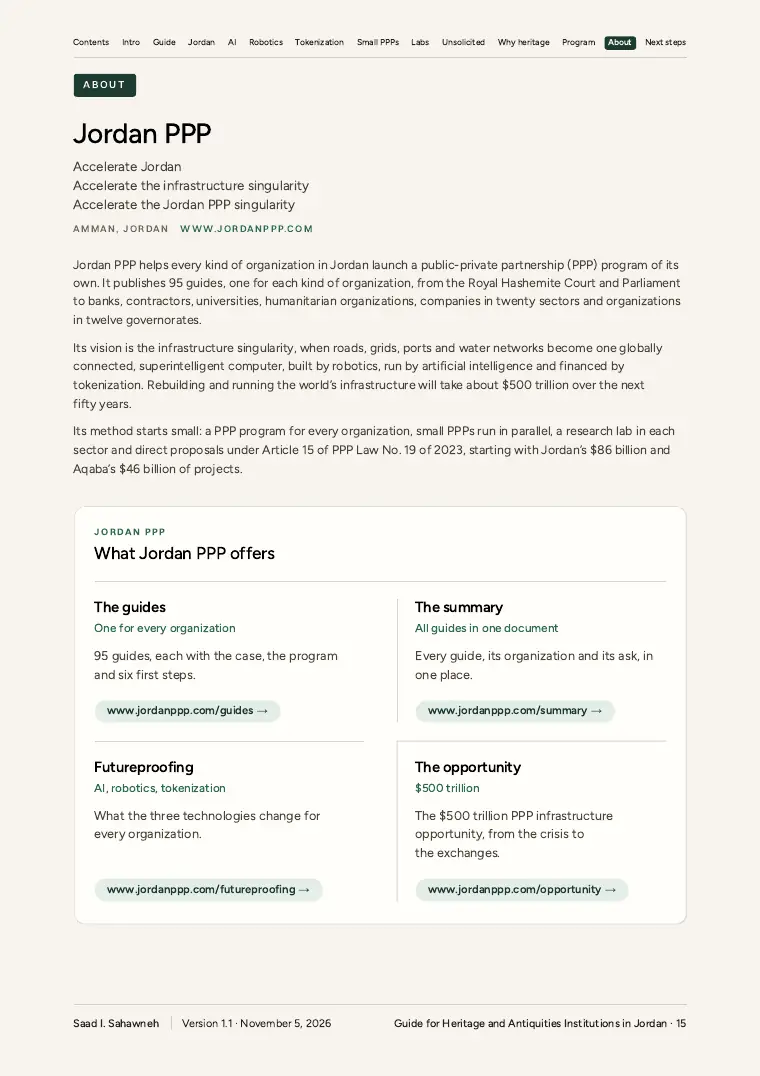
12About
About Jordan PPP and what it offers.
Page 15 of 17
13Next steps
How a heritage institution can start: six first steps.
Page 16 of 17
Questions
Questions about the guide for Heritage and Antiquities Institutions in Jordan
- What does the guide for Heritage and Antiquities Institutions in Jordan propose?
- Your institution launches a PPP program to build and run visitor centers, museums, conservation labs, digital records and heritage trails as public-private partnerships (PPPs), with conservation first.
- Why should heritage and antiquities institutions in Jordan launch a PPP program?
- Heritage institutions guard what every visitor comes to see. Jordan’s monuments, museums and collections draw visitors from around the world and support the towns around them. The visitor centers, labs and services at a heritage site suit the long contracts of a PPP, where a partner builds and runs them and part of the revenue pays for conservation.
- Which PPP projects can heritage and antiquities institutions in Jordan take part in?
- Jordan has about $86 billion of PPP and infrastructure projects in development, $46 billion of them anchored in Aqaba. Many of them, from roads and water lines to hotels and urban renewal, will be built on or near land that holds Jordan’s antiquities. A Jordanian heritage institution that runs one site concession at home can carry the same model to heritage sites across the region.
- How can heritage and antiquities institutions in Jordan start a PPP program?
- Any heritage or antiquities institution in Jordan can take this guide forward. The first steps use the sites, collections and specialists it already has. The guide sets out six first steps: mandate, team, pipeline, sites, partners and pilot.
- What does a PPP program give heritage and antiquities institutions in Jordan?
- The institution gains steady concession revenue that pays for excavation, conservation and research, partners who finance the visitor centers and labs it needs and jobs for the communities around every site.
- Is the guide for Heritage and Antiquities Institutions in Jordan free?
- Yes. It is free to read on this page and free to download as a 17-page PDF, with the case for a PPP program, Jordan’s pipeline, the role of AI, robotics and tokenization, the program and six first steps.
Guide 84 of 95
Browse all 95 guides