
What this guide is for
Your company launches a PPP program to build, equip and run freight and passenger rail lines, rail links to Aqaba’s port, rolling stock and maintenance depots as public-private partnerships (PPPs).
The case
Rail companies carry the heavy loads every economy depends on
Railways have long been built by the state and run by a single operator, with track, trains and stations held in one public block. The railways of the next fifty years will be financed in parts, with track, rolling stock, depots and services each held under long contracts by the companies best able to run them. This guide invites rail companies in Jordan to launch a PPP program, starting with the projects at home.
The guide
Put the $500 trillion PPP infrastructure opportunity on track
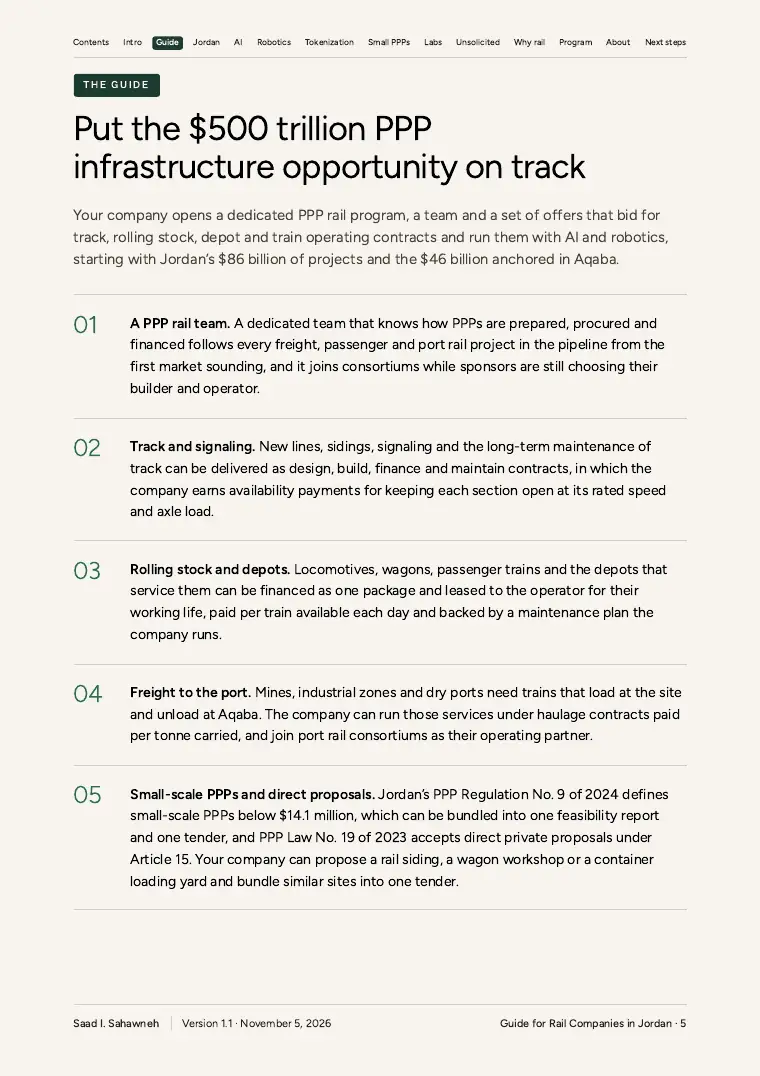
Your company opens a dedicated PPP rail program, a team and a set of offers that bid for track, rolling stock, depot and train operating contracts and run them with AI and robotics, starting with Jordan’s $86 billion of projects and the $46 billion anchored in Aqaba.
01
A PPP rail team
A dedicated team that knows how PPPs are prepared, procured and financed follows every freight, passenger and port rail project in the pipeline from the first market sounding, and it joins consortiums while sponsors are still choosing their builder and operator.
02
Track and signaling
New lines, sidings, signaling and the long-term maintenance of track can be delivered as design, build, finance and maintain contracts, in which the company earns availability payments for keeping each section open at its rated speed and axle load.
03
Rolling stock and depots
Locomotives, wagons, passenger trains and the depots that service them can be financed as one package and leased to the operator for their working life, paid per train available each day and backed by a maintenance plan the company runs.
04
Freight to the port
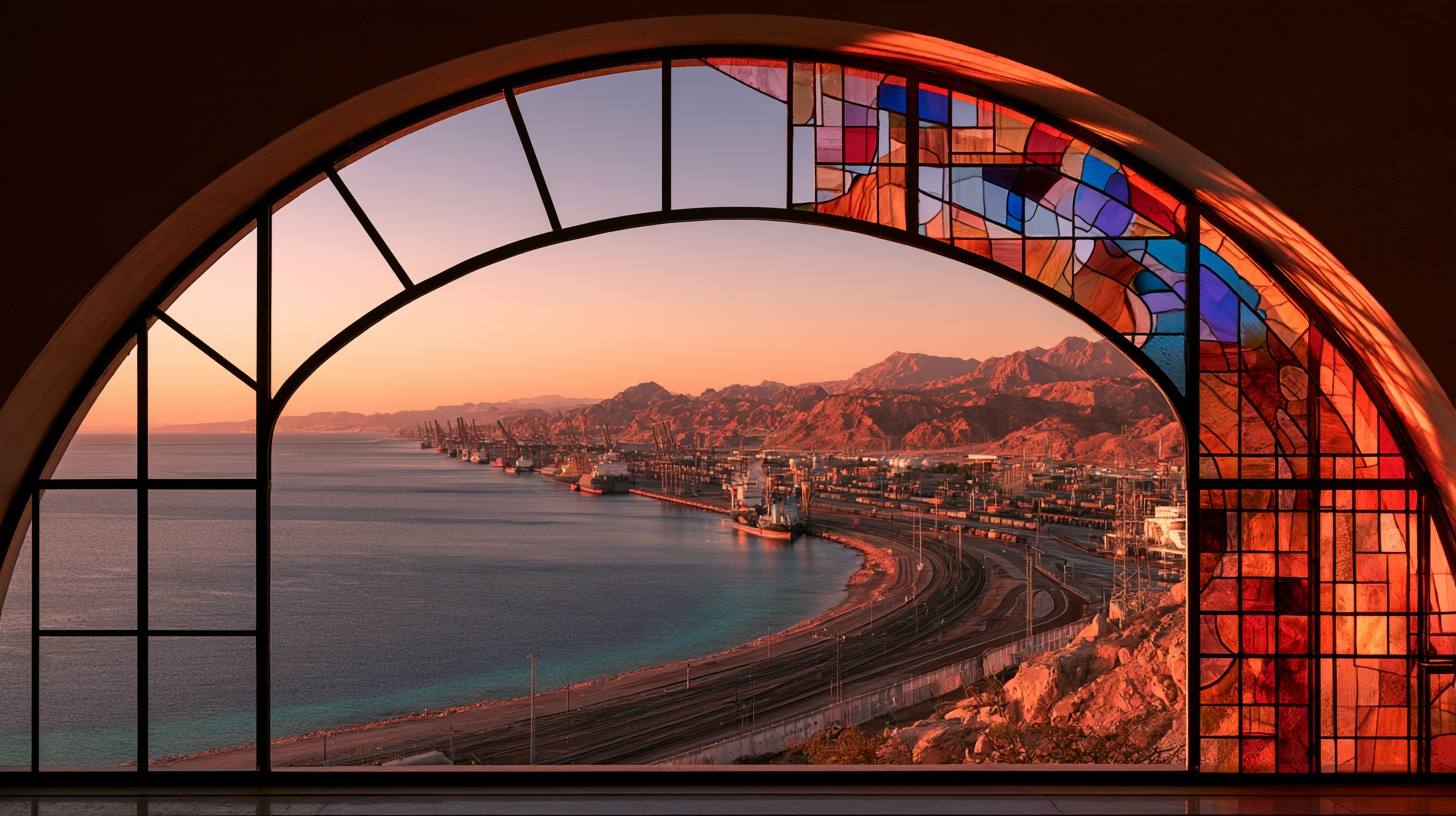
Mines, industrial zones and dry ports need trains that load at the site and unload at Aqaba. The company can run those services under haulage contracts paid per tonne carried, and join port rail consortiums as their operating partner.
05
Small-scale PPPs and direct proposals
Jordan’s PPP Regulation No. 9 of 2024 defines small-scale PPPs below $14.1 million, which can be bundled into one feasibility report and one tender, and PPP Law No. 19 of 2023 accepts direct private proposals under Article 15. Your company can propose a rail siding, a wagon workshop or a container loading yard and bundle similar sites into one tender.
Why rail companies
Rail companies carry the heavy loads every economy depends on
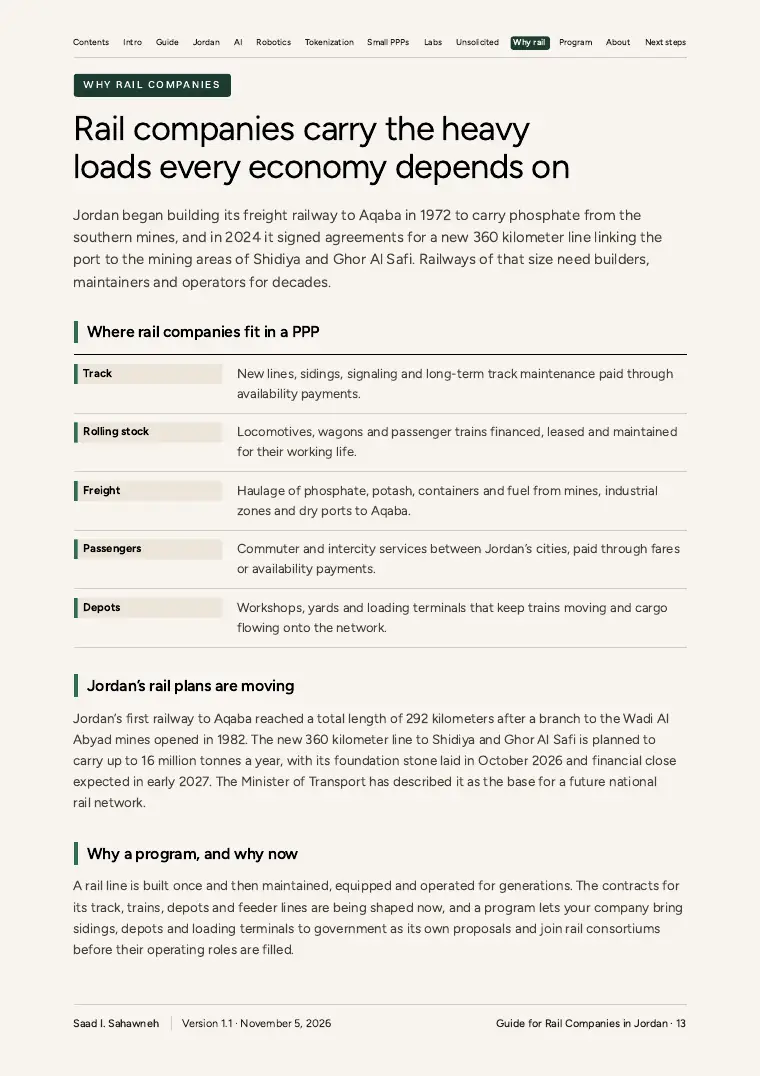
Jordan began building its freight railway to Aqaba in 1972 to carry phosphate from the southern mines, and in 2024 it signed agreements for a new 360 kilometer line linking the port to the mining areas of Shidiya and Ghor Al Safi. Railways of that size need builders, maintainers and operators for decades.
Where rail companies fit in a PPP
- Track
- New lines, sidings, signaling and long-term track maintenance paid through availability payments.
- Rolling stock
- Locomotives, wagons and passenger trains financed, leased and maintained for their working life.
- Freight
- Haulage of phosphate, potash, containers and fuel from mines, industrial zones and dry ports to Aqaba.
- Passengers
- Commuter and intercity services between Jordan’s cities, paid through fares or availability payments.
- Depots
- Workshops, yards and loading terminals that keep trains moving and cargo flowing onto the network.
Jordan’s rail plans are moving
Jordan’s first railway to Aqaba reached a total length of 292 kilometers after a branch to the Wadi Al Abyad mines opened in 1982. The new 360 kilometer line to Shidiya and Ghor Al Safi is planned to carry up to 16 million tonnes a year, with its foundation stone laid in October 2026 and financial close expected in early 2027. The Minister of Transport has described it as the base for a future national rail network.
Why a program, and why now
A rail line is built once and then maintained, equipped and operated for generations. The contracts for its track, trains, depots and feeder lines are being shaped now, and a program lets your company bring sidings, depots and loading terminals to government as its own proposals and join rail consortiums before their operating roles are filled.

Futureproofing
Futureproof Rail Companies in Jordan for the infrastructure singularity
This free 17-page guide shows how, with small PPPs in parallel, PPP research labs, artificial intelligence, robotics, tokenization and six first steps.
Jordan and Aqaba
An $86 billion pipeline to start with
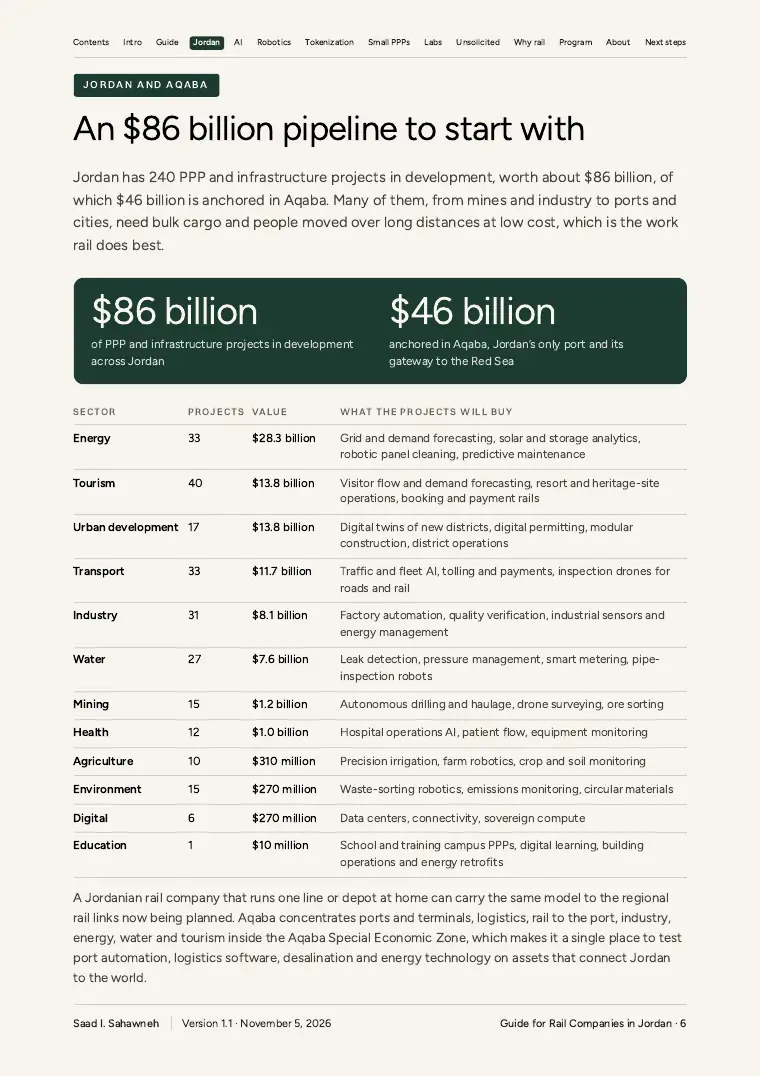
Many of them, from mines and industry to ports and cities, need bulk cargo and people moved over long distances at low cost, which is the work rail does best. A Jordanian rail company that runs one line or depot at home can carry the same model to the regional rail links now being planned.
- $86B
- of PPP and infrastructure projects in development in Jordan
- $46B
- of them anchored in Aqaba

Artificial intelligence
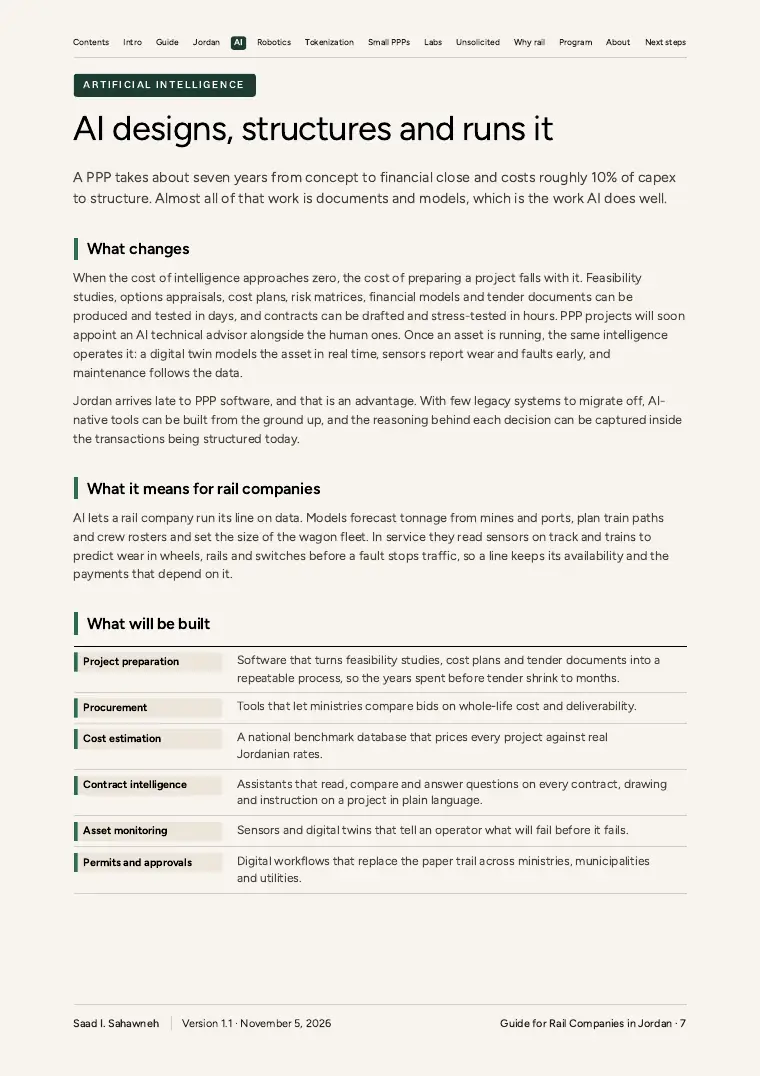
AI lets a rail company run its line on data. Models forecast tonnage from mines and ports, plan train paths and crew rosters and set the size of the wagon fleet. In service they read sensors on track and trains to predict wear in wheels, rails and switches before a fault stops traffic, so a line keeps its availability and the payments that depend on it.

Robotics
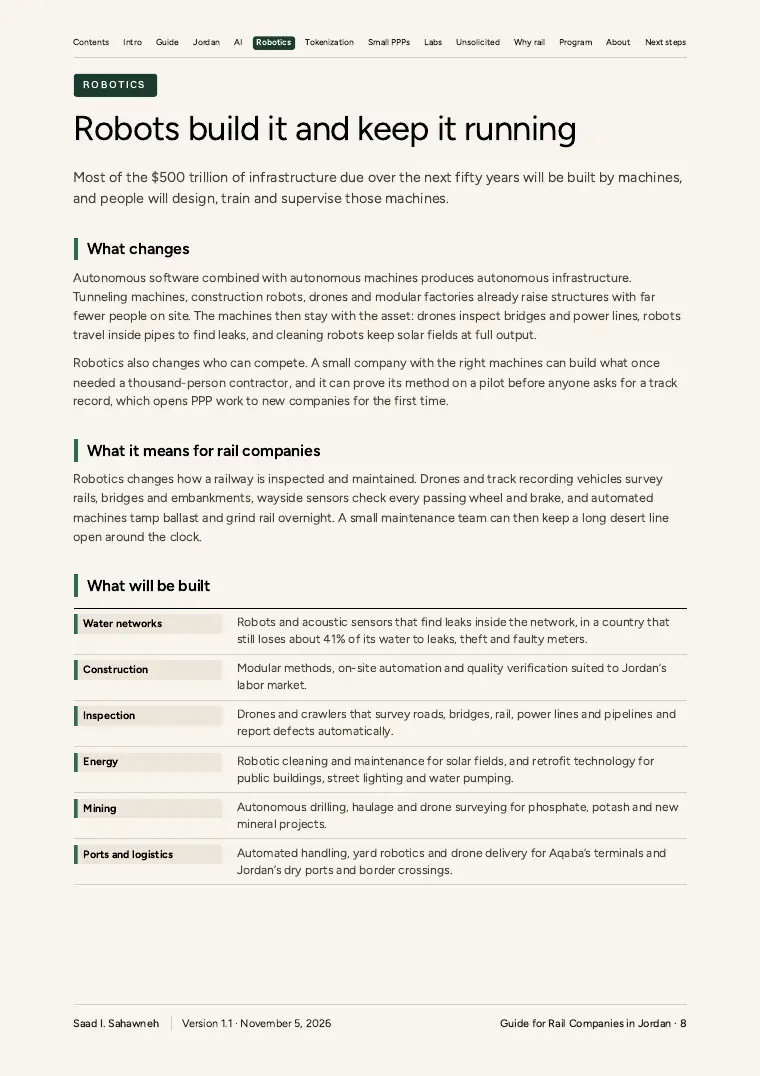
Robotics changes how a railway is inspected and maintained. Drones and track recording vehicles survey rails, bridges and embankments, wayside sensors check every passing wheel and brake, and automated machines tamp ballast and grind rail overnight. A small maintenance team can then keep a long desert line open around the clock.

Tokenization
A railway earns from every tonne and passenger it carries for decades, and its wagons and locomotives can be leased like any other long-life asset. A rail company can offer tokenized stakes in the rolling stock and depots it finances, pay holders from lease and haulage payments as they arrive and publish tonnage and availability data, so investors follow the line as it performs.

Small PPPs and research labs
A rail siding, a loading yard or a wagon workshop is small enough to tender as a small PPP and close enough to the main line to matter. A rail company can run lab pilots on sensors, inspection drones and maintenance robots at those sites, measure the time and cost they save and carry the methods that work onto the main line.

Unsolicited proposals
A rail company knows where cargo stays on the road because no siding reaches it and where trains wait for a depot or a loading point. A direct proposal lets it turn that knowledge into a siding, yard or workshop of its own design, and keep the right to match the best offer if the project goes to tender.
The program
How the program could work
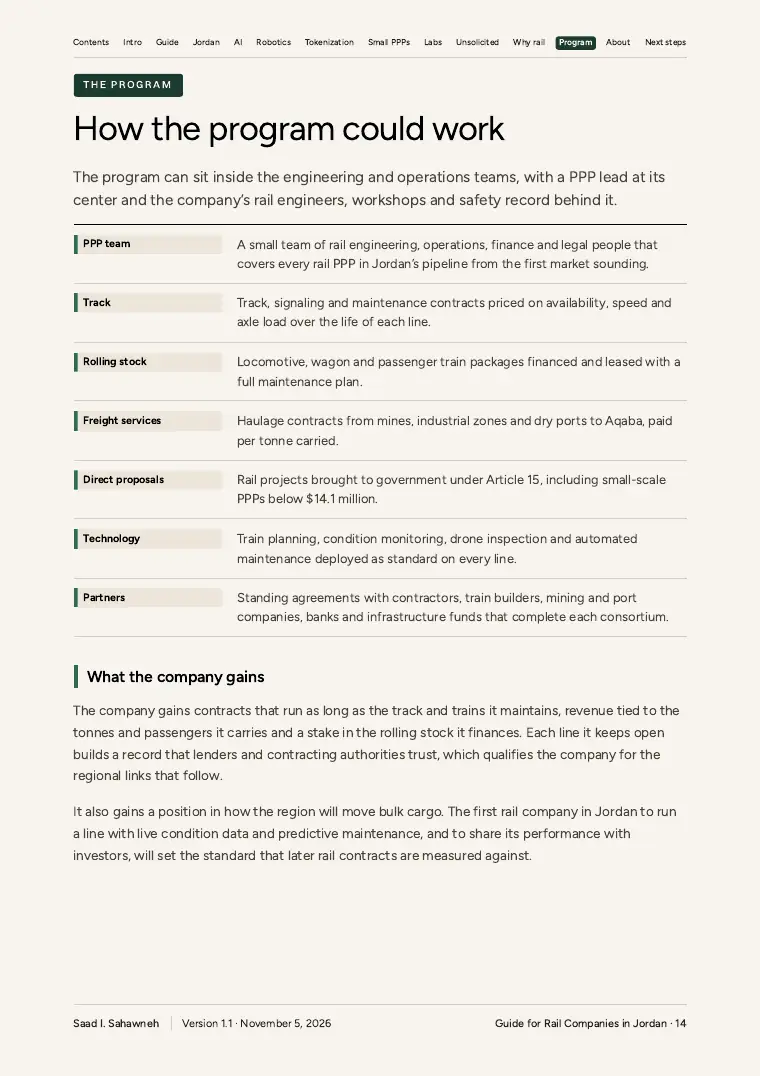
The program can sit inside the engineering and operations teams, with a PPP lead at its center and the company’s rail engineers, workshops and safety record behind it.
- PPP team
- A small team of rail engineering, operations, finance and legal people that covers every rail PPP in Jordan’s pipeline from the first market sounding.
- Track
- Track, signaling and maintenance contracts priced on availability, speed and axle load over the life of each line.
- Rolling stock
- Locomotive, wagon and passenger train packages financed and leased with a full maintenance plan.
- Freight services
- Haulage contracts from mines, industrial zones and dry ports to Aqaba, paid per tonne carried.
- Direct proposals
- Rail projects brought to government under Article 15, including small-scale PPPs below $14.1 million.
- Technology
- Train planning, condition monitoring, drone inspection and automated maintenance deployed as standard on every line.
- Partners
- Standing agreements with contractors, train builders, mining and port companies, banks and infrastructure funds that complete each consortium.
What the company gains
The company gains contracts that run as long as the track and trains it maintains, revenue tied to the tonnes and passengers it carries and a stake in the rolling stock it finances. Each line it keeps open builds a record that lenders and contracting authorities trust, which qualifies the company for the regional links that follow.
It also gains a position in how the region will move bulk cargo. The first rail company in Jordan to run a line with live condition data and predictive maintenance, and to share its performance with investors, will set the standard that later rail contracts are measured against.

Next steps
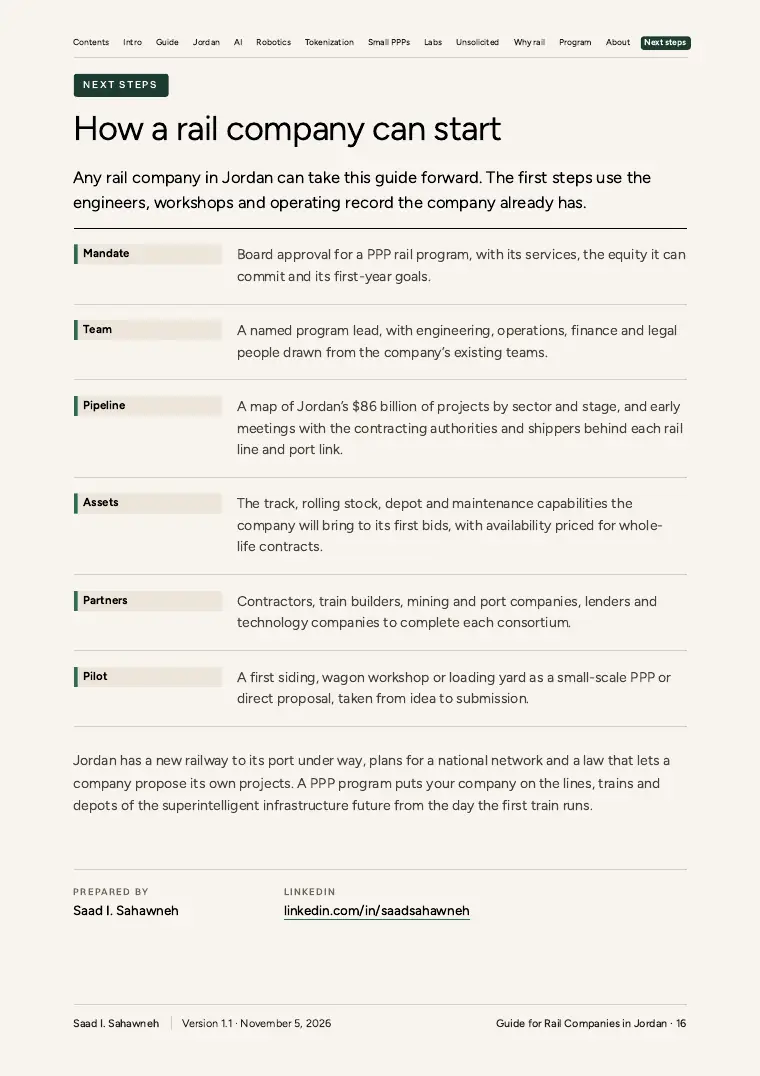
How a rail company can start
Any rail company in Jordan can take this guide forward. The first steps use the engineers, workshops and operating record the company already has.
01
Mandate
Board approval for a PPP rail program, with its services, the equity it can commit and its first-year goals.
02
Team
A named program lead, with engineering, operations, finance and legal people drawn from the company’s existing teams.
03
Pipeline
A map of Jordan’s $86 billion of projects by sector and stage, and early meetings with the contracting authorities and shippers behind each rail line and port link.
04
Assets
The track, rolling stock, depot and maintenance capabilities the company will bring to its first bids, with availability priced for whole-life contracts.
05
Partners
Contractors, train builders, mining and port companies, lenders and technology companies to complete each consortium.
06
Pilot
A first siding, wagon workshop or loading yard as a small-scale PPP or direct proposal, taken from idea to submission.
Jordan has a new railway to its port under way, plans for a national network and a law that lets a company propose its own projects. A PPP program puts your company on the lines, trains and depots of the superintelligent infrastructure future from the day the first train runs.
The full document
Inside this guide
Seventeen pages and thirteen chapters, from the case for a PPP program to the first steps, written for rail companies in Jordan.
- 17
- pages
- 13
- chapters
- 3
- technologies
- 6
- first steps
01Introduction
Why a century of infrastructure needs rebuilding, and the $500 trillion it will take.
Page 3 of 17
02The guide
Put the $500 trillion PPP infrastructure opportunity on track
Page 5 of 17
03Jordan and Aqaba
An $86 billion pipeline to start with
Page 6 of 17
04Artificial intelligence
How AI designs, structures and runs PPP projects, and what it means for rail companies.
Page 7 of 17
05Robotics
How robots build infrastructure and keep it running, and what that means for rail companies.
Page 8 of 17
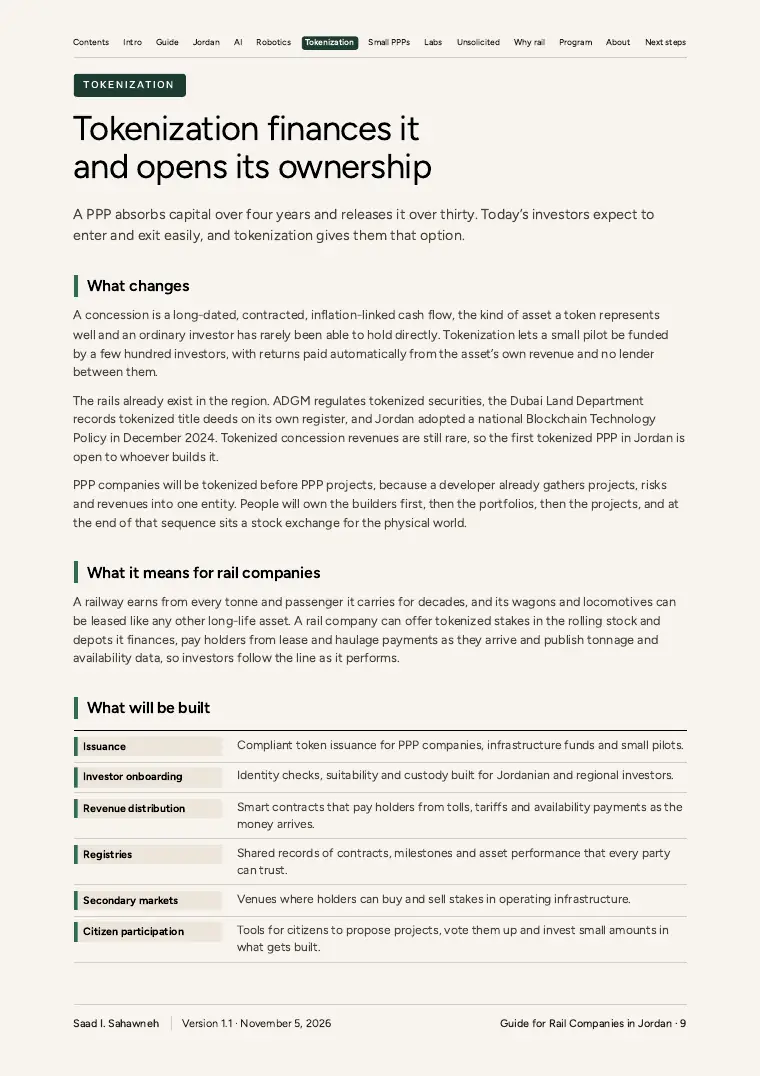
06Tokenization
How tokenization funds projects from their own revenue, and the role it opens for rail companies.
Page 9 of 17
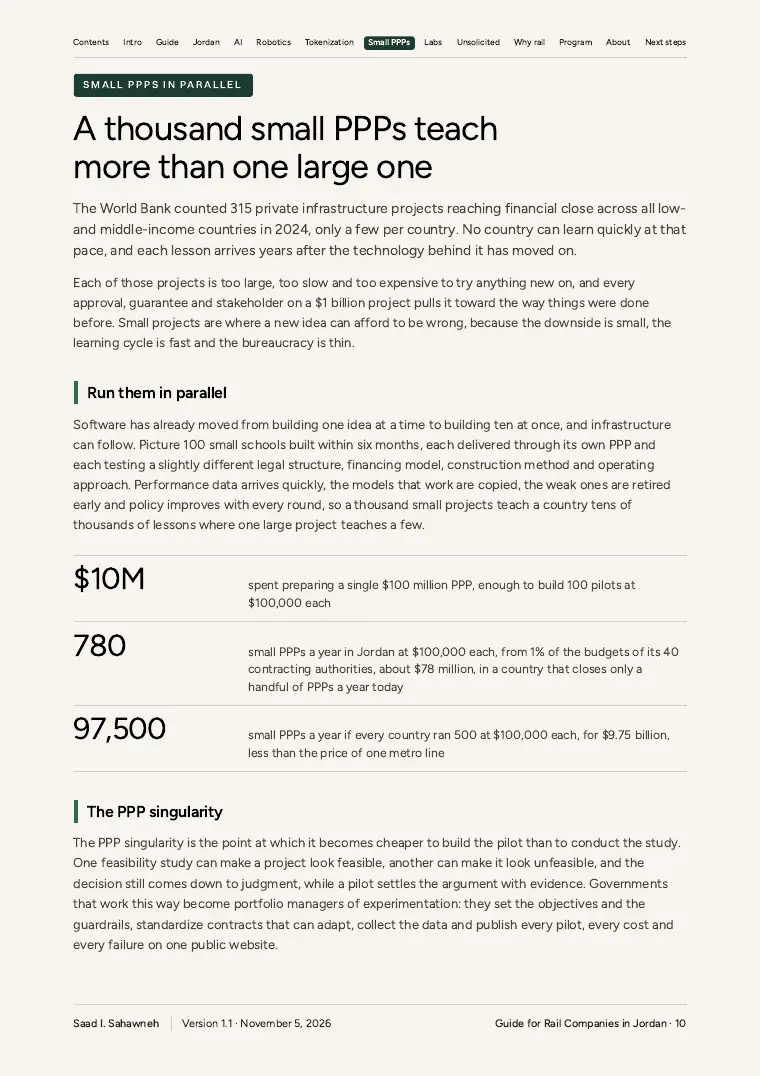
07Small PPPs in parallel
Why many small PPPs teach a country faster than a few large ones.
Page 10 of 17
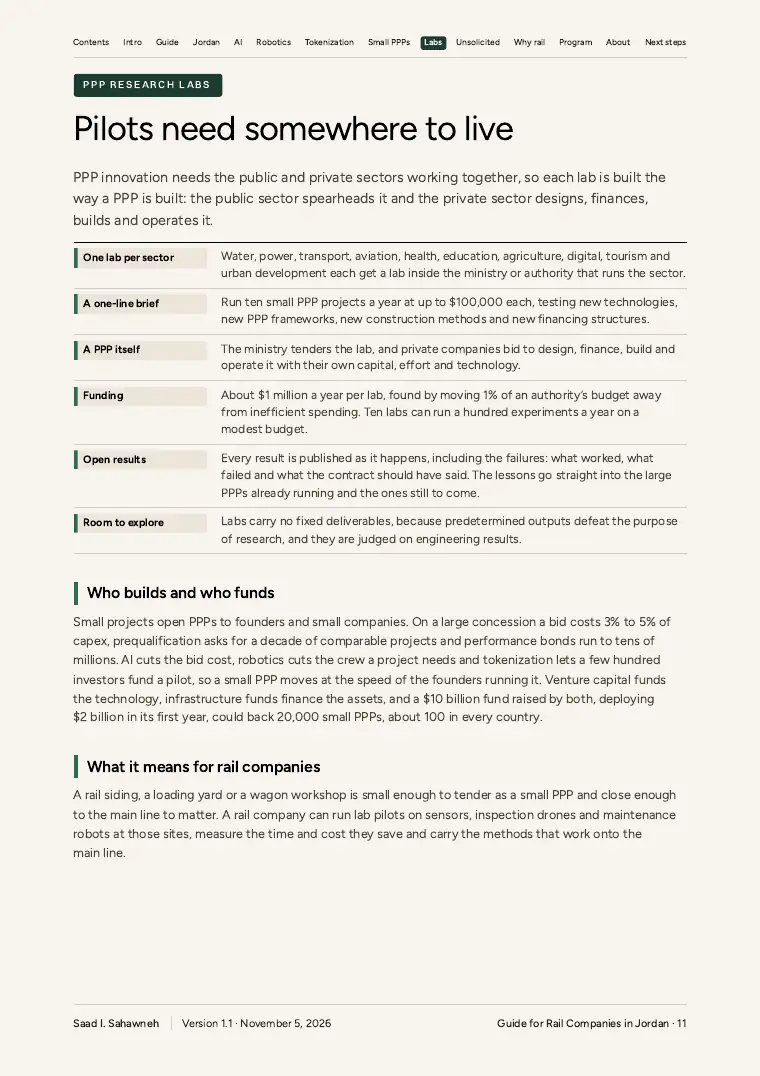
08PPP research labs
A lab in each sector, running ten small PPP projects a year.
Page 11 of 17
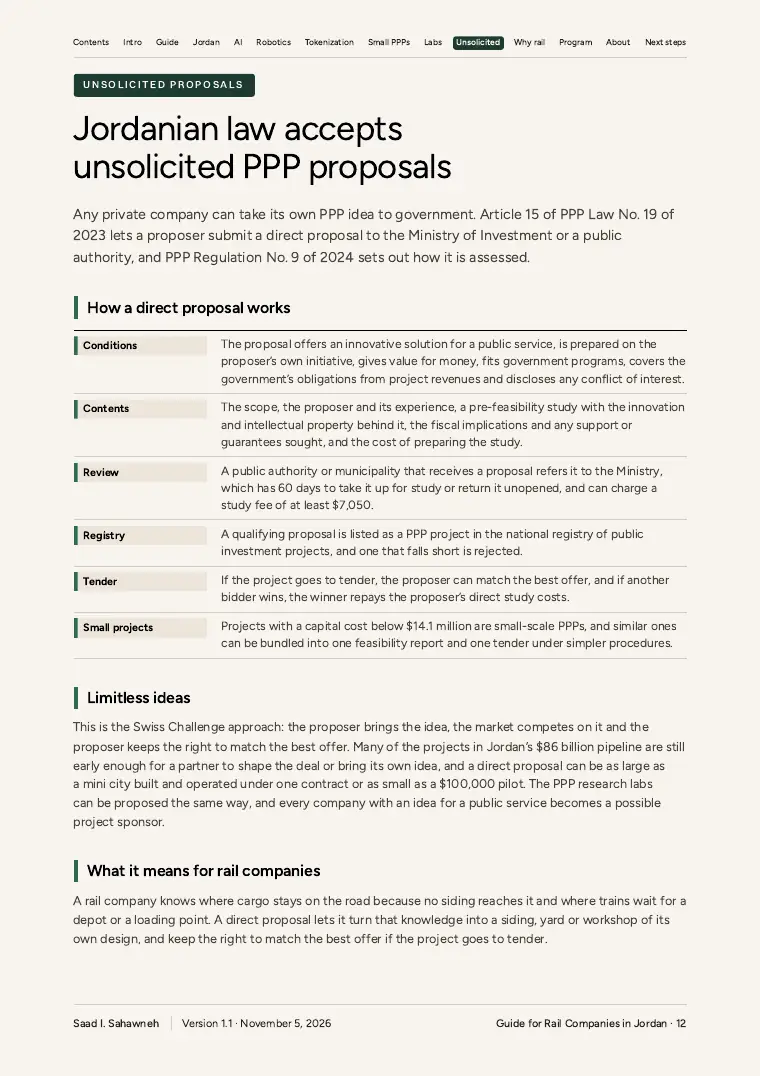
09Unsolicited proposals
How Jordan’s PPP law accepts direct proposals from private companies.
Page 12 of 17
10Why rail companies
Rail companies carry the heavy loads every economy depends on
Page 13 of 17
11The program
The program can sit inside the engineering and operations teams, with a PPP lead at its center and the company’s rail engineers, workshops and safety record behind it.
Page 14 of 17
12About
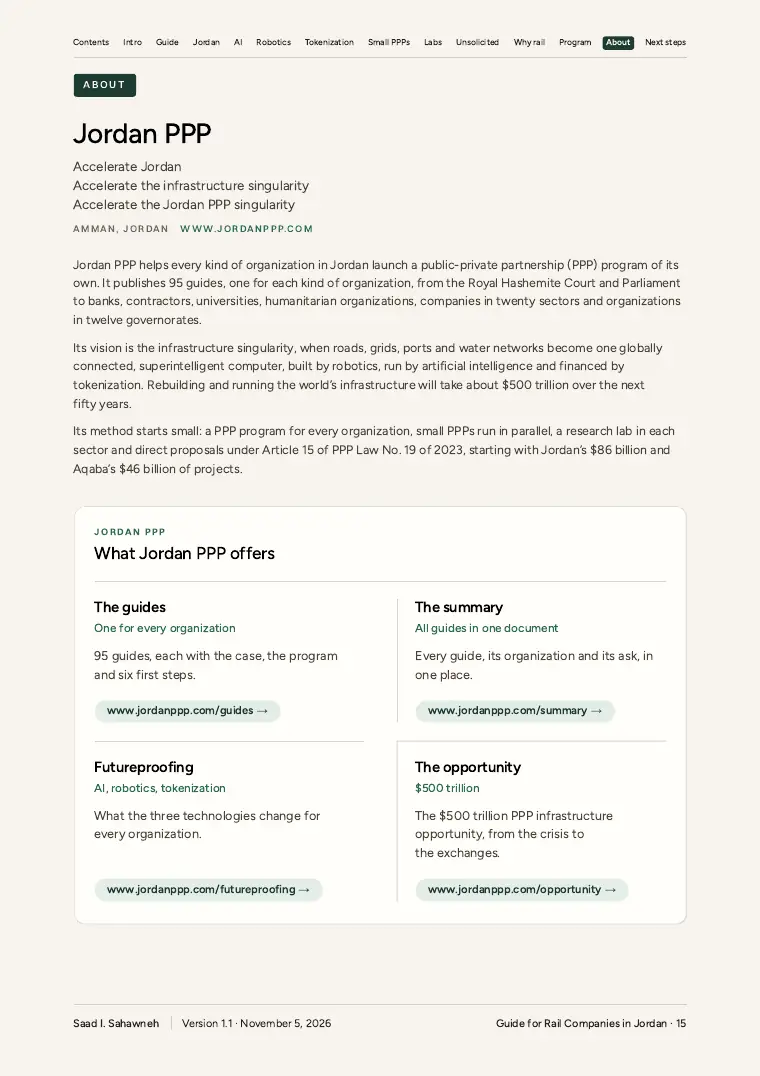
About Jordan PPP and what it offers.
Page 15 of 17
13Next steps
How a rail company can start: six first steps.
Page 16 of 17
Questions
Questions about the guide for Rail Companies in Jordan
- What does the guide for Rail Companies in Jordan propose?
- Your company launches a PPP program to build, equip and run freight and passenger rail lines, rail links to Aqaba’s port, rolling stock and maintenance depots as public-private partnerships (PPPs).
- Why should rail companies in Jordan launch a PPP program?
- Rail companies carry the heavy loads every economy depends on. Jordan began building its freight railway to Aqaba in 1972 to carry phosphate from the southern mines, and in 2024 it signed agreements for a new 360 kilometer line linking the port to the mining areas of Shidiya and Ghor Al Safi. Railways of that size need builders, maintainers and operators for decades.
- Which PPP projects can rail companies in Jordan take part in?
- Jordan has about $86 billion of PPP and infrastructure projects in development, $46 billion of them anchored in Aqaba. Many of them, from mines and industry to ports and cities, need bulk cargo and people moved over long distances at low cost, which is the work rail does best. A Jordanian rail company that runs one line or depot at home can carry the same model to the regional rail links now being planned.
- How can rail companies in Jordan start a PPP program?
- Any rail company in Jordan can take this guide forward. The first steps use the engineers, workshops and operating record the company already has. The guide sets out six first steps: mandate, team, pipeline, assets, partners and pilot.
- What does a PPP program give rail companies in Jordan?
- The company gains contracts that run as long as the track and trains it maintains, revenue tied to the tonnes and passengers it carries and a stake in the rolling stock it finances. Each line it keeps open builds a record that lenders and contracting authorities trust, which qualifies the company for the regional links that follow.
- Is the guide for Rail Companies in Jordan free?
- Yes. It is free to read on this page and free to download as a 17-page PDF, with the case for a PPP program, Jordan’s pipeline, the role of AI, robotics and tokenization, the program and six first steps.
Guide 51 of 95
Browse all 95 guides