
What this guide is for
Your company launches a PPP program to build and run marine terminals, ferry services, ship services, repair yards and maritime training as public-private partnerships (PPPs) at Aqaba and beyond, starting with Aqaba’s $46 billion and Jordan’s $86 billion of projects.
The case
Maritime companies keep Jordan connected to the sea
Ports and ferries have long been run by public bodies, with shipping lines and service companies working around them on short permits. The maritime infrastructure of the next fifty years will be financed and run by the companies that serve the ships, under long contracts that reward fast turnarounds, clean operations and well-trained crews. This guide invites maritime and shipping companies in Jordan to launch a PPP program, starting with the projects at home.
The guide
Sail into the $500 trillion PPP infrastructure opportunity
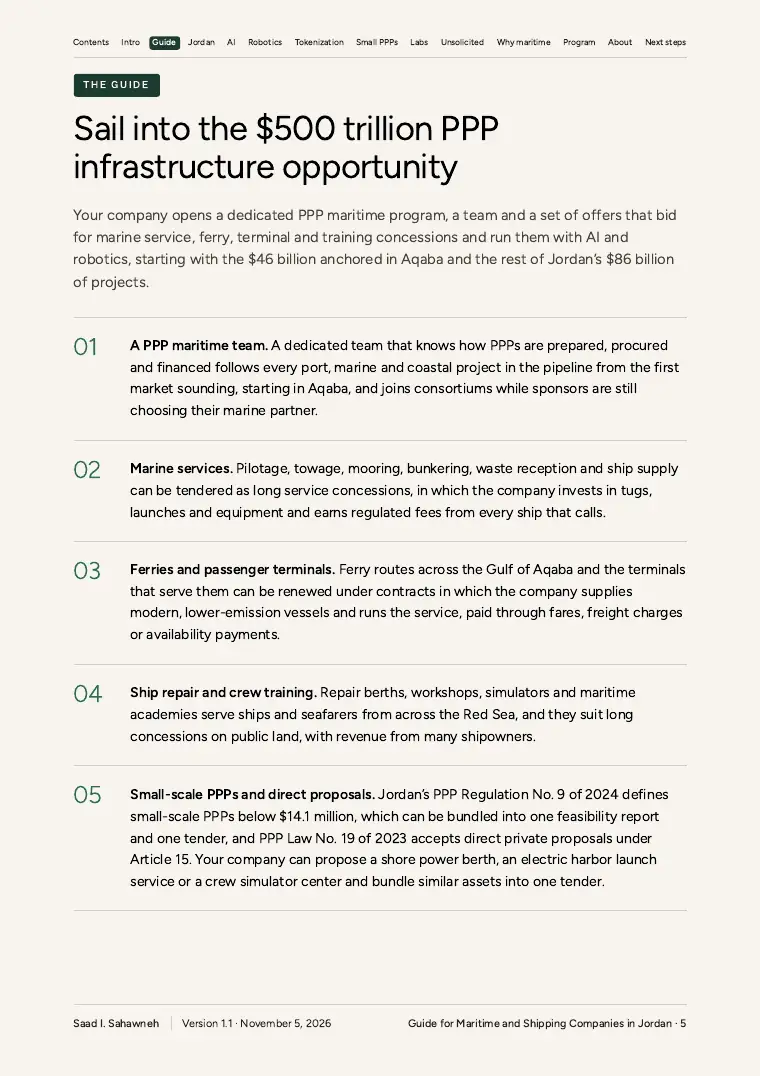
Your company opens a dedicated PPP maritime program, a team and a set of offers that bid for marine service, ferry, terminal and training concessions and run them with AI and robotics, starting with the $46 billion anchored in Aqaba and the rest of Jordan’s $86 billion of projects.
01
A PPP maritime team
A dedicated team that knows how PPPs are prepared, procured and financed follows every port, marine and coastal project in the pipeline from the first market sounding, starting in Aqaba, and joins consortiums while sponsors are still choosing their marine partner.
02
Marine services
Pilotage, towage, mooring, bunkering, waste reception and ship supply can be tendered as long service concessions, in which the company invests in tugs, launches and equipment and earns regulated fees from every ship that calls.
03
Ferries and passenger terminals
Ferry routes across the Gulf of Aqaba and the terminals that serve them can be renewed under contracts in which the company supplies modern, lower-emission vessels and runs the service, paid through fares, freight charges or availability payments.
04
Ship repair and crew training
Repair berths, workshops, simulators and maritime academies serve ships and seafarers from across the Red Sea, and they suit long concessions on public land, with revenue from many shipowners.
05
Small-scale PPPs and direct proposals
Jordan’s PPP Regulation No. 9 of 2024 defines small-scale PPPs below $14.1 million, which can be bundled into one feasibility report and one tender, and PPP Law No. 19 of 2023 accepts direct private proposals under Article 15. Your company can propose a shore power berth, an electric harbor launch service or a crew simulator center and bundle similar assets into one tender.
Why maritime and shipping companies
Maritime companies keep Jordan connected to the sea
Aqaba is Jordan’s gateway to the Red Sea, and every ship that calls there needs pilots, tugs, berths, supplies and trained crews. Ferries across the gulf carried 140,000 passengers between Aqaba and Nuweiba in the first half of 2024, up 30 percent on the year before.
Where maritime companies fit in a PPP
- Shipping lines
- Liner and charter services that anchor demand for new berths, terminals and feeder routes.
- Marine services
- Pilotage, towage, mooring, bunkering and waste reception run as long service concessions.
- Terminals
- Specialized berths for passengers, cruise ships, bulk, fuel and roll-on roll-off cargo at Aqaba.
- Ferries
- Passenger, vehicle and truck ferries across the Gulf of Aqaba, with the terminals that serve them.
- Training
- Maritime academies, simulators and certification courses for officers, engineers and ratings.
Jordan already has the framework
The Jordan Maritime Commission, set up in 2002 and based in Aqaba, registers ships under the Jordanian flag and inspects ships calling at Aqaba under the Mediterranean Memorandum of Understanding on port state control. Ferries on the Aqaba to Nuweiba route also carried 42,000 trucks in the first half of 2024, so a new marine concession joins a regulated sector with steady traffic.
Why a program, and why now
Every energy, mining, tourism and industrial project planned for Aqaba will bring more ships to its berths, and the marine services, ferries and training those ships need are still being planned. A program gives a maritime company a team, a fleet plan and the partners to bid, and the companies that join consortiums first will serve Aqaba’s ships for decades.

Futureproofing
Futureproof Maritime and Shipping Companies in Jordan for the infrastructure singularity
This free 17-page guide shows how, with small PPPs in parallel, PPP research labs, artificial intelligence, robotics, tokenization and six first steps.
Jordan and Aqaba
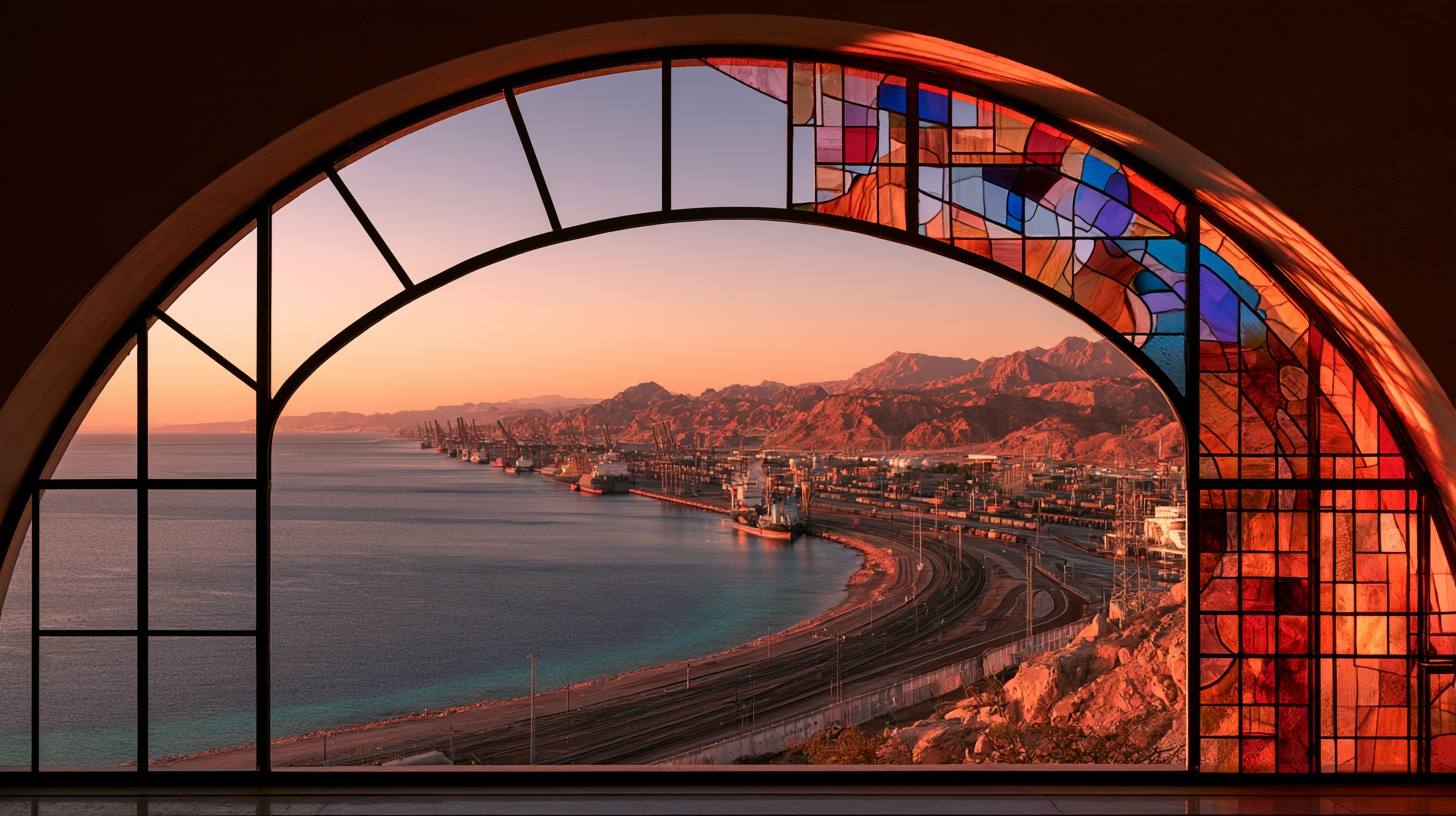
An $86 billion pipeline to start with
Many of them, from energy and mining to tourism and trade, depend on ships reaching Aqaba and on the marine services that keep them moving safely. A Jordanian maritime company that runs one marine concession at Aqaba can carry the same model to ports across the Red Sea and beyond.
- $86B
- of PPP and infrastructure projects in development in Jordan
- $46B
- of them anchored in Aqaba

Artificial intelligence
AI turns a harbor into one planned flow of ships. Models forecast arrivals, plan pilots, tugs and berths before a ship enters the gulf, set speed and fuel use on each voyage and predict engine faults before they delay a sailing. A maritime company that runs those models in a concession serves more ships with the same fleet of tugs and launches.

Robotics
Robotics is reaching every part of ship service. Underwater drones inspect hulls, moorings and quay walls, hull-cleaning robots remove fouling without divers and autonomous survey boats chart the seabed. A maritime company can bring that equipment into its concessions, cut the time ships spend alongside and train Jordanian technicians to run and repair it.

Tokenization
A tug fleet, a ferry or a repair berth earns fees from every ship it serves, and those vessels and berths have long, well-understood working lives. A maritime company can offer tokenized stakes in the PPP assets it runs, pay holders from service fees and fares as they arrive and publish ship calls and service data, so investors follow each asset as it earns.

Small PPPs and research labs
Small PPPs let a maritime company test new vessels and services in a busy harbor at low risk. It can run lab pilots on electric harbor launches, shore power, underwater inspection drones and crew simulators, publish the fuel, time and safety results and carry the pilots that work into its larger concessions.

Unsolicited proposals
A maritime company sees every day where ships wait for a pilot, a tug, a berth or a repair. A direct proposal lets it turn that knowledge into a marine service, ferry or training project of its own design, and keep the right to match the best offer if the project goes to tender.
The program
How the program could work
The program can sit beside the company’s fleet and marine operations, with a PPP lead at its center and the vessels, crews and safety record the company already has behind it.
- PPP team
- A small team of marine operations, technical, finance and legal people that covers every port and maritime PPP in Jordan’s pipeline from the first market sounding.
- Marine services
- Pilotage, towage, mooring, bunkering and waste reception concessions priced on response times and safety records.
- Ferries
- Passenger and freight ferry services and terminals, with modern lower-emission vessels sized into each bid.
- Terminals
- Operating roles in passenger, cruise and specialized cargo terminal consortiums at Aqaba.
- Training
- Maritime academies, simulators and repair workshops run as concessions that serve the whole Red Sea.
- Direct proposals
- Maritime projects brought to government under Article 15, including small-scale PPPs below $14.1 million.
- Partners
- Standing agreements with shipping lines, shipyards, port operators, banks and infrastructure funds that complete each consortium.
What the company gains
The company gains concessions that run for decades, fees from every ship it serves and a stake in the vessels and berths it finances. Each concession builds a safety and service record that lenders, shipowners and contracting authorities trust, which qualifies the company for ports across the Red Sea.
It also gains a lead in how ships will be served. The first maritime company in the region to run AI-planned, robot-inspected and low-emission marine services, and to share its performance with investors, will set the standard that later marine concessions are measured against.

Next steps
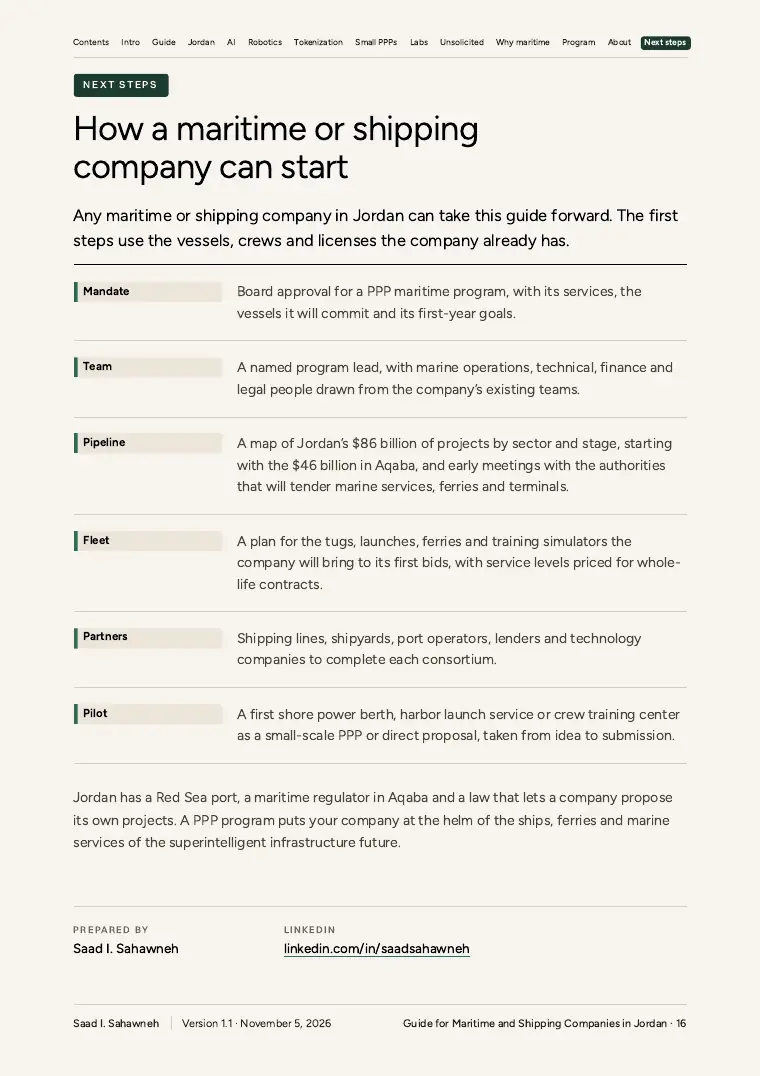
How a maritime or shipping company can start
Any maritime or shipping company in Jordan can take this guide forward. The first steps use the vessels, crews and licenses the company already has.
01
Mandate
Board approval for a PPP maritime program, with its services, the vessels it will commit and its first-year goals.
02
Team
A named program lead, with marine operations, technical, finance and legal people drawn from the company’s existing teams.
03
Pipeline
A map of Jordan’s $86 billion of projects by sector and stage, starting with the $46 billion in Aqaba, and early meetings with the authorities that will tender marine services, ferries and terminals.
04
Fleet
A plan for the tugs, launches, ferries and training simulators the company will bring to its first bids, with service levels priced for whole-life contracts.
05
Partners
Shipping lines, shipyards, port operators, lenders and technology companies to complete each consortium.
06
Pilot
A first shore power berth, harbor launch service or crew training center as a small-scale PPP or direct proposal, taken from idea to submission.
Jordan has a Red Sea port, a maritime regulator in Aqaba and a law that lets a company propose its own projects. A PPP program puts your company at the helm of the ships, ferries and marine services of the superintelligent infrastructure future.
The full document
Inside this guide
Seventeen pages and thirteen chapters, from the case for a PPP program to the first steps, written for maritime and shipping companies in Jordan.
- 17
- pages
- 13
- chapters
- 3
- technologies
- 6
- first steps
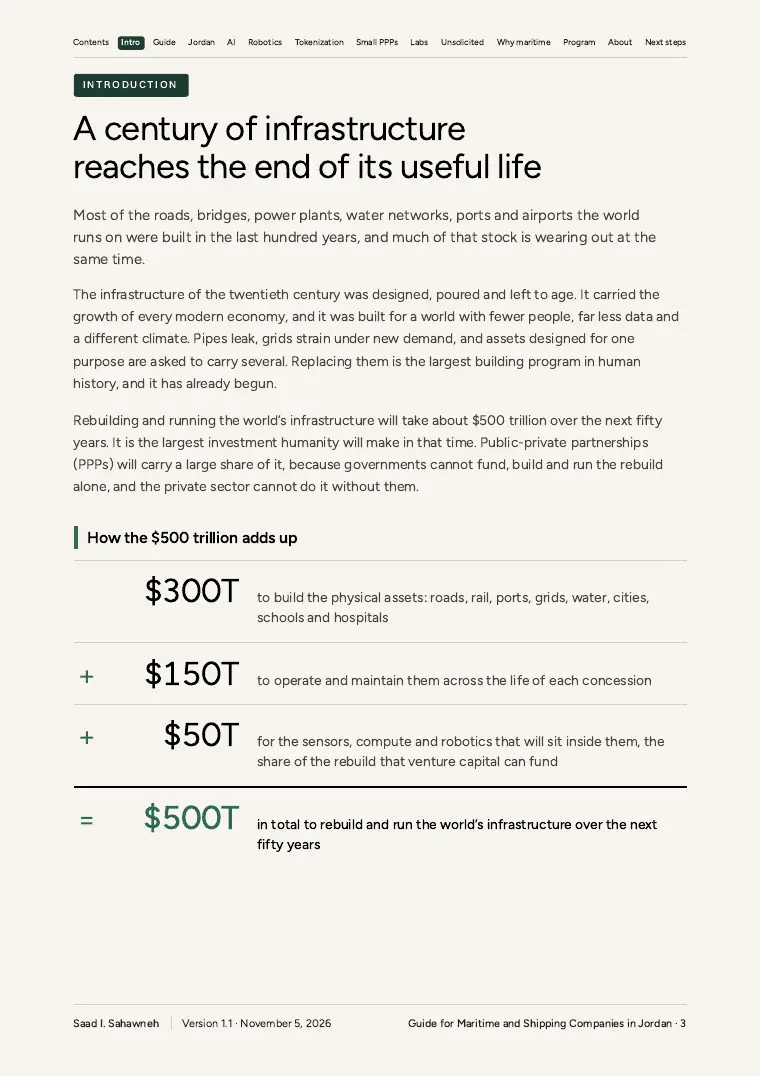
01Introduction
Why a century of infrastructure needs rebuilding, and the $500 trillion it will take.
Page 3 of 17
02The guide
Sail into the $500 trillion PPP infrastructure opportunity
Page 5 of 17
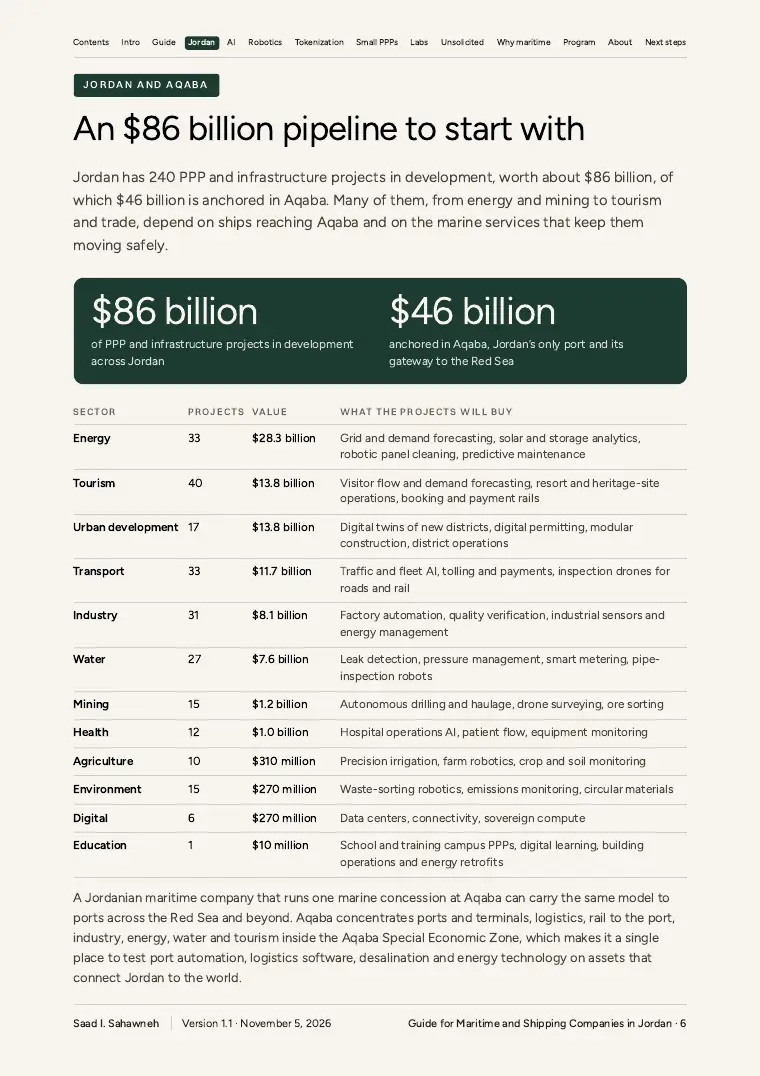
03Jordan and Aqaba
An $86 billion pipeline to start with
Page 6 of 17
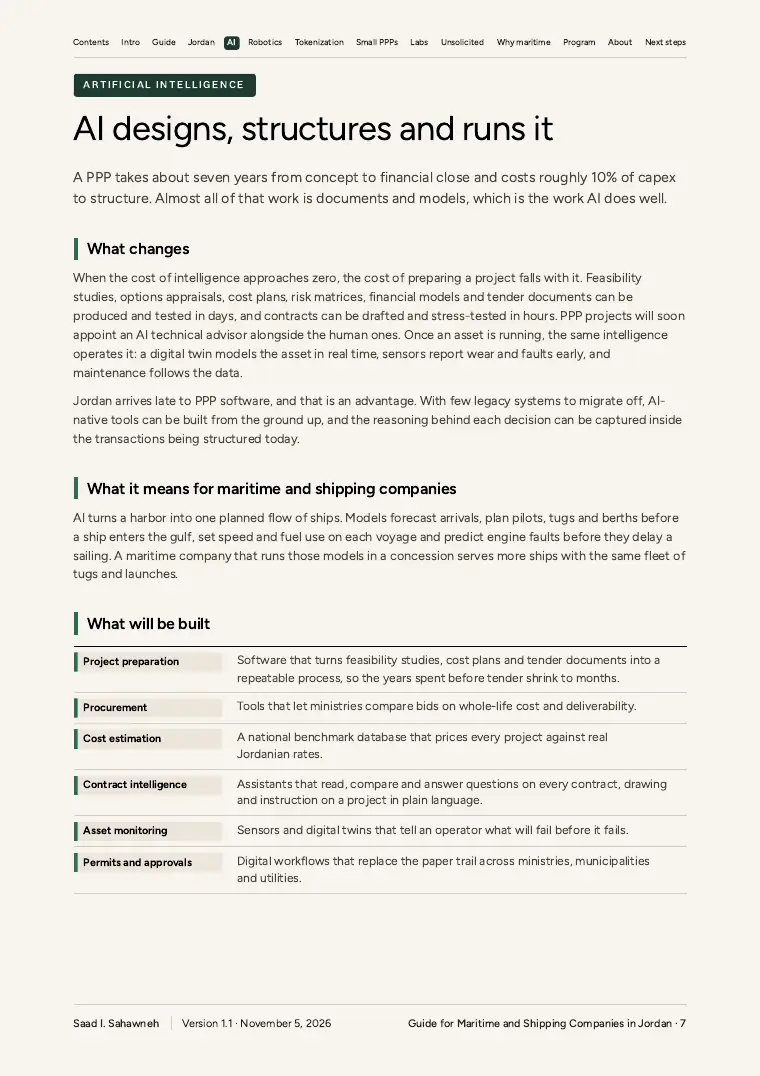
04Artificial intelligence
How AI designs, structures and runs PPP projects, and what it means for maritime and shipping companies.
Page 7 of 17
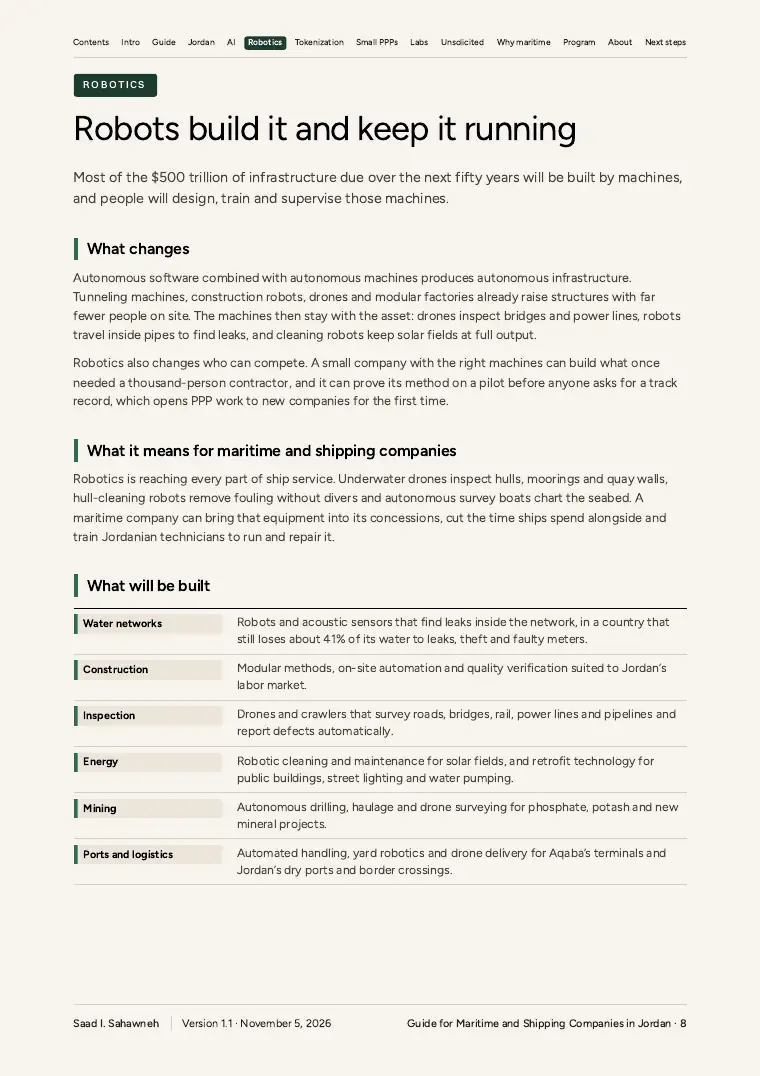
05Robotics
How robots build infrastructure and keep it running, and what that means for maritime and shipping companies.
Page 8 of 17
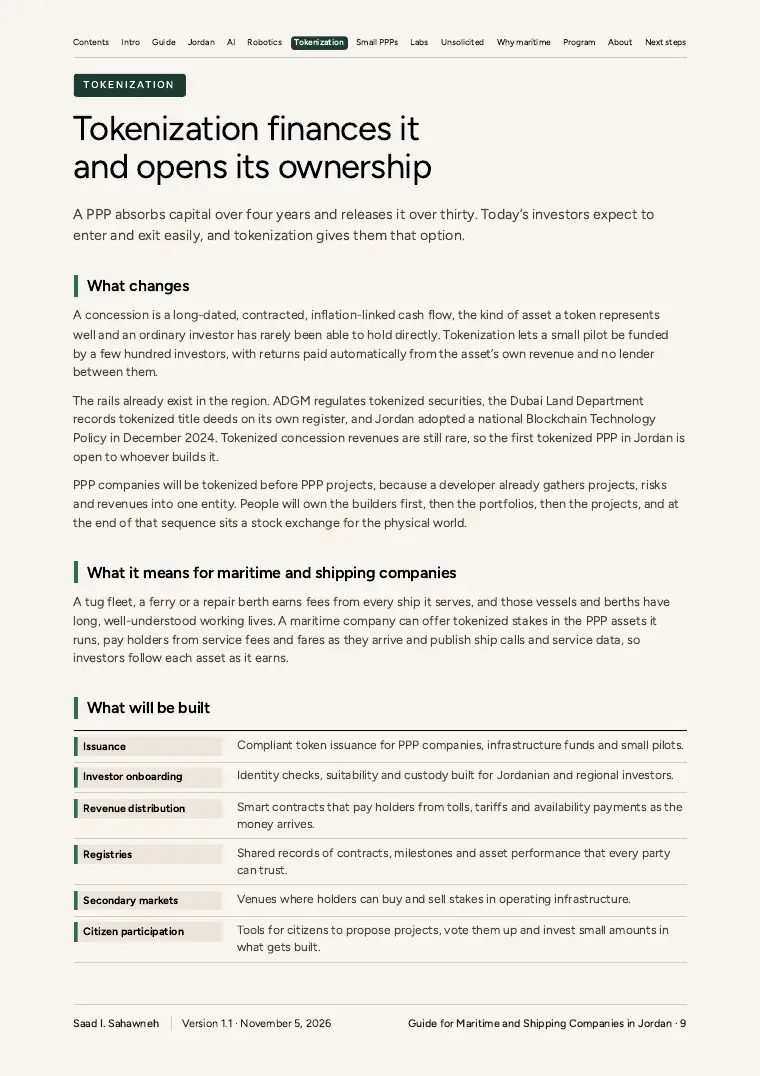
06Tokenization
How tokenization funds projects from their own revenue, and the role it opens for maritime and shipping companies.
Page 9 of 17
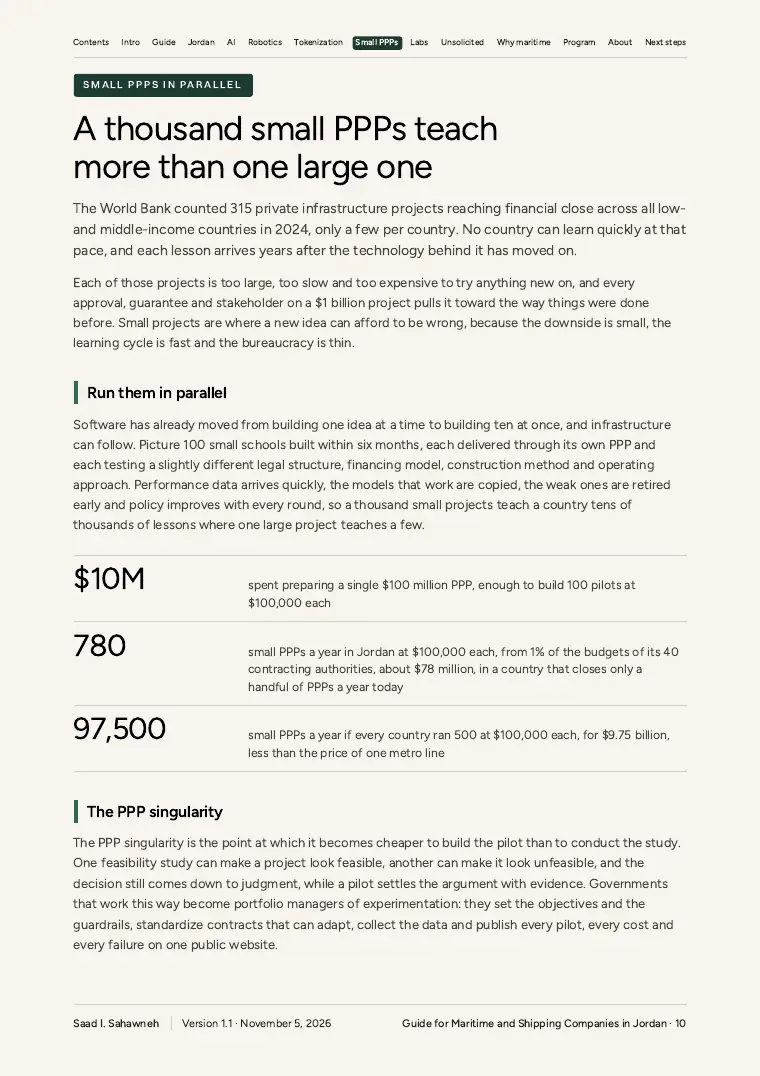
07Small PPPs in parallel
Why many small PPPs teach a country faster than a few large ones.
Page 10 of 17
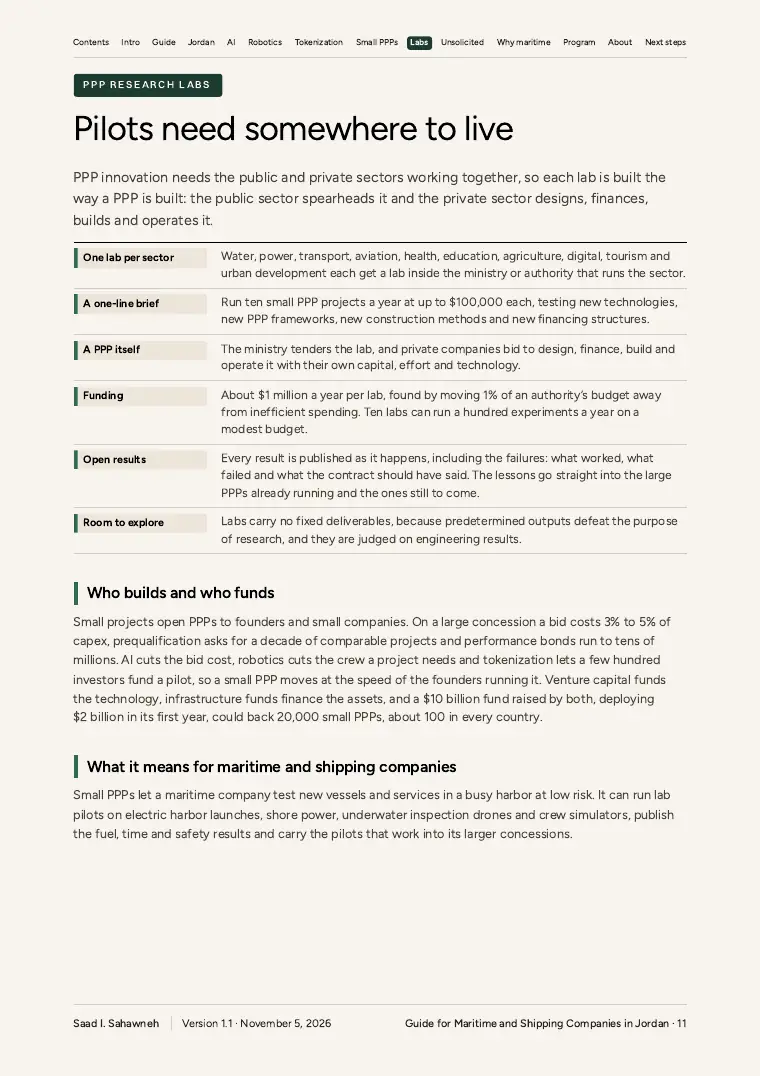
08PPP research labs
A lab in each sector, running ten small PPP projects a year.
Page 11 of 17
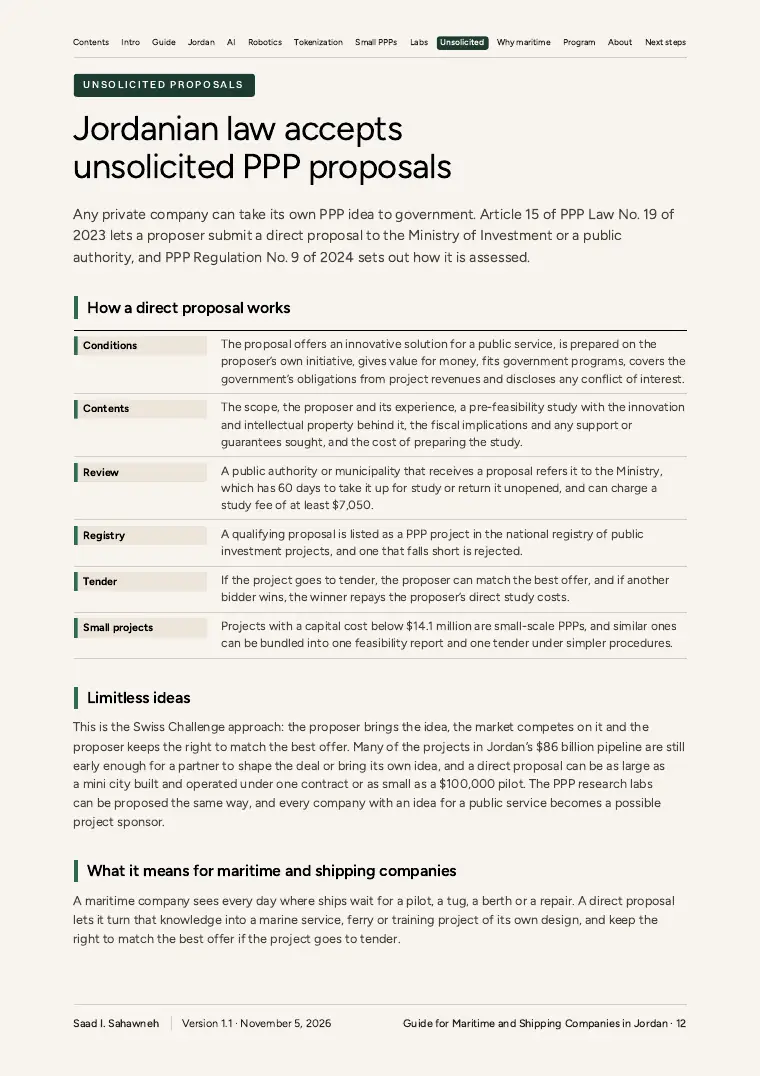
09Unsolicited proposals
How Jordan’s PPP law accepts direct proposals from private companies.
Page 12 of 17
10Why maritime and shipping companies
Maritime companies keep Jordan connected to the sea
Page 13 of 17
11The program
The program can sit beside the company’s fleet and marine operations, with a PPP lead at its center and the vessels, crews and safety record the company already has behind it.
Page 14 of 17
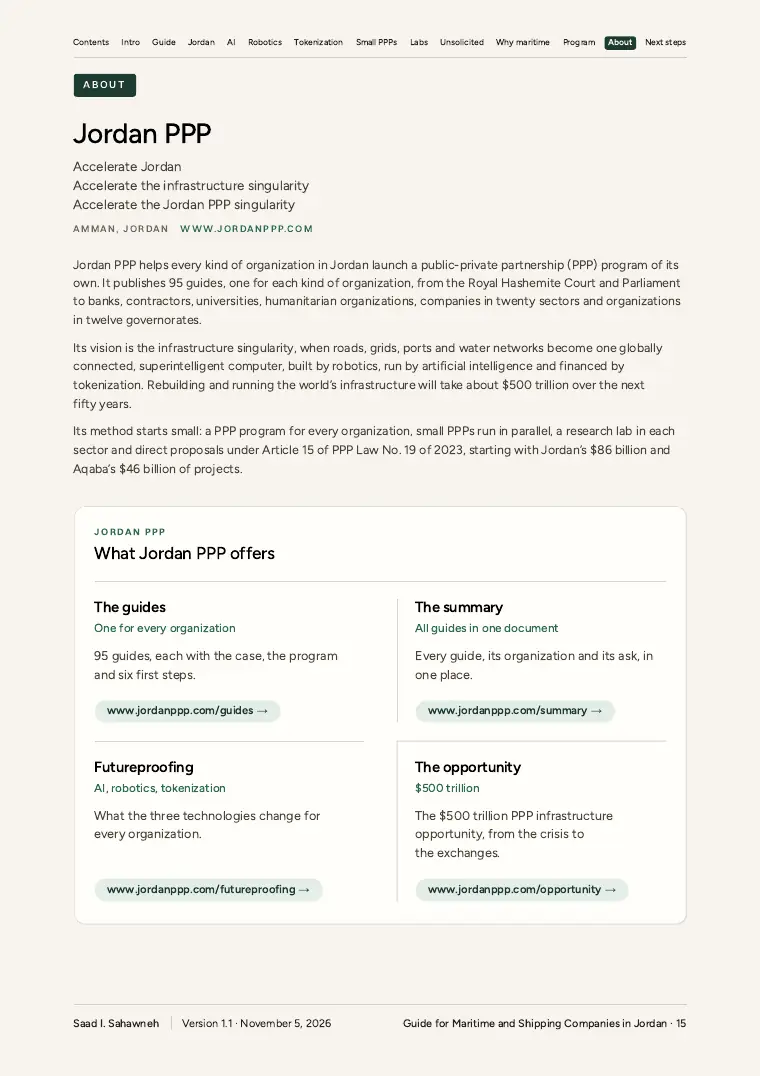
12About
About Jordan PPP and what it offers.
Page 15 of 17
13Next steps
How a maritime or shipping company can start: six first steps.
Page 16 of 17
Questions
Questions about the guide for Maritime and Shipping Companies in Jordan
- What does the guide for Maritime and Shipping Companies in Jordan propose?
- Your company launches a PPP program to build and run marine terminals, ferry services, ship services, repair yards and maritime training as public-private partnerships (PPPs) at Aqaba and beyond, starting with Aqaba’s $46 billion and Jordan’s $86 billion of projects.
- Why should maritime and shipping companies in Jordan launch a PPP program?
- Maritime companies keep Jordan connected to the sea. Aqaba is Jordan’s gateway to the Red Sea, and every ship that calls there needs pilots, tugs, berths, supplies and trained crews. Ferries across the gulf carried 140,000 passengers between Aqaba and Nuweiba in the first half of 2024, up 30 percent on the year before.
- Which PPP projects can maritime and shipping companies in Jordan take part in?
- Jordan has about $86 billion of PPP and infrastructure projects in development, $46 billion of them anchored in Aqaba. Many of them, from energy and mining to tourism and trade, depend on ships reaching Aqaba and on the marine services that keep them moving safely. A Jordanian maritime company that runs one marine concession at Aqaba can carry the same model to ports across the Red Sea and beyond.
- How can maritime and shipping companies in Jordan start a PPP program?
- Any maritime or shipping company in Jordan can take this guide forward. The first steps use the vessels, crews and licenses the company already has. The guide sets out six first steps: mandate, team, pipeline, fleet, partners and pilot.
- What does a PPP program give maritime and shipping companies in Jordan?
- The company gains concessions that run for decades, fees from every ship it serves and a stake in the vessels and berths it finances. Each concession builds a safety and service record that lenders, shipowners and contracting authorities trust, which qualifies the company for ports across the Red Sea.
- Is the guide for Maritime and Shipping Companies in Jordan free?
- Yes. It is free to read on this page and free to download as a 17-page PDF, with the case for a PPP program, Jordan’s pipeline, the role of AI, robotics and tokenization, the program and six first steps.
Guide 50 of 95
Browse all 95 guides