· 7 min read
Jordan PPP law 2023: what PPP Law No. 19 means for projects in Jordan and Aqaba
What Jordan’s PPP Law No. 19 of 2023 and PPP Regulation No. 9 of 2024 say, who they cover and how organizations in Jordan and Aqaba can use them.
Jordan’s PPP law is PPP Law No. 19 of 2023, which took effect on November 13, 2023, read with PPP Regulation No. 9 of 2024, which followed in March 2024. Together they strengthen the PPP Unit at the Ministry of Investment, let any private company take its own PPP idea to government under Article 15, and define small-scale PPPs below $14.1 million that can be bundled into one feasibility report and one tender. This post explains what the law says, who it covers and what it means for Aqaba, where $46 billion of Jordan’s $86 billion of PPP and infrastructure projects are anchored.
What is Jordan’s PPP law in 2023?
Jordan’s PPP law is PPP Law No. 19 of 2023, which took effect on November 13, 2023 and strengthened the PPP Unit at the Ministry of Investment. It is the third PPP law Jordan has passed. PPP Regulation No. 9 of 2024 followed in March 2024 and sets out how direct proposals are studied and how small-scale PPPs work.
In plain words, the law decides who can sign a PPP contract in Jordan, how a company can bring its own idea to government and how small projects can move faster. A PPP itself is a long contract in which a private partner builds or runs a public asset or service and is paid for its performance, usually for 20 to 30 years. The starting guide explains the model from zero, with a short history of PPPs in Jordan and a glossary of the words you will hear most.
How did Jordan’s PPP law change between 2014 and 2023?
Jordan has passed three PPP laws, each one to make the next projects easier. PPP Law No. 31 of 2014 set up a PPP Unit at the Ministry of Finance and a PPP Council chaired by the Prime Minister. Law No. 17 of 2020 replaced it, and Law No. 19 of 2023 followed.
- 012014. PPP Law No. 31 of 2014 sets up a PPP Unit at the Ministry of Finance and a PPP Council chaired by the Prime Minister.
- 022019. A Cabinet decision moves the PPP Unit to the Prime Ministry.
- 032020. PPP Law No. 17 of 2020 replaces the 2014 law.
- 042023. PPP Law No. 19 of 2023 takes effect on November 13, 2023 and strengthens the PPP Unit at the Ministry of Investment.
- 052024. PPP Regulation No. 9 of 2024 follows in March 2024.
Projects kept moving while the laws changed. The 117 MW Tafila Wind Farm started generating in 2015, and Shams Ma’an began selling power to NEPCO under a 20-year agreement in 2016. A group led by Meridiam and Suez signed the BOT contract for the Aqaba-Amman Water Desalination and Conveyance project on January 12, 2025, and the final agreement for the National Water Carrier was signed on April 21, 2026.
Who can sign a PPP contract under Jordan’s PPP law?
Under PPP Law No. 19 of 2023, ministries and public authorities in Jordan act as contracting authorities, and the law counts a company wholly or majority owned by the government as a public authority. State-owned water companies, the power transmission company and rail companies can therefore sign PPP contracts and receive direct proposals themselves.
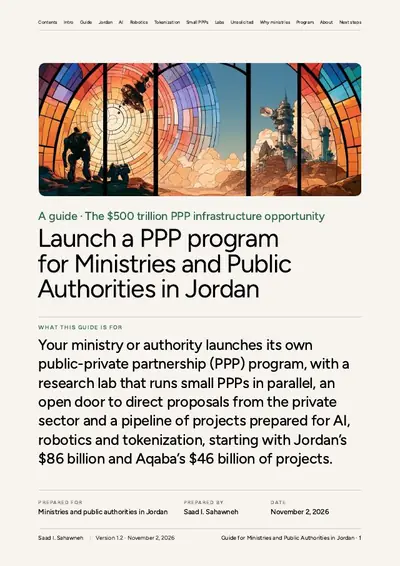
A contracting authority chooses which projects go to market, how they are prepared and what the contracts reward, so the way it works sets the pace for everyone else. The ministries and public authorities guidePDF proposes a PPP unit inside each ministry, a small team of technical, legal, financial and procurement staff that prepares, tenders and supervises its PPPs.
The state-owned utilities guidePDF shows how a company can be the contracting authority on its own projects, with a proposal it receives going to the Ministry for review. The public sector category gathers the guides for the authorities that plan, contract, own and regulate public-private partnerships.
How does Article 15 let companies propose PPPs in Jordan?
Article 15 of Jordan’s PPP Law No. 19 of 2023 lets any private company take its own PPP idea to the Ministry of Investment or a public authority, and PPP Regulation No. 9 of 2024 sets out how it is studied. If the project goes to tender, the proposer can match the best offer.
Article 15 asks for an innovative solution for a public service. A proposal must show value for money, its fiscal implications and how project revenues cover the government’s obligations. Every direct proposal needs a pre-feasibility study, a technical scope and a cost estimate before the Ministry will study it.
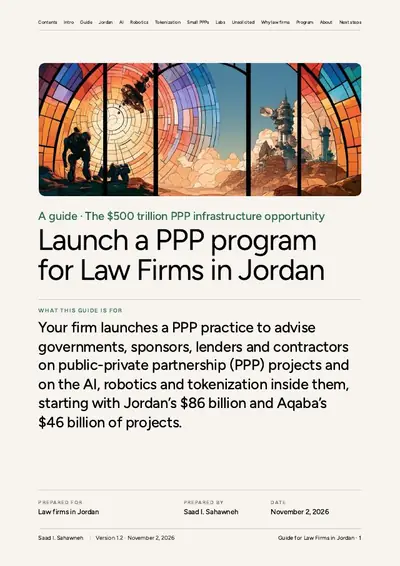
The rules protect the proposer’s early work. The authority can charge the proposer a study fee for each review and a qualifying proposal enters the PPP Registry, while the tender still tests the idea against the market. The proposer can match the best offer, and the winning bidder pays the proposer’s direct study costs. The unsolicited proposals page explains the route for each kind of organization, and the law firms guidePDF lists the legal work involved: the intellectual property in the idea, the conflict-of-interest disclosure and the proposer’s rights at tender.
What does PPP Regulation No. 9 of 2024 say about small PPPs?
PPP Regulation No. 9 of 2024 defines small-scale PPPs in Jordan as projects below $14.1 million. Similar small projects can be bundled into one feasibility report and one tender under simpler procedures, so street lights across many districts or car parks across several towns can go to market as a single project.
$14.1M
the ceiling for small-scale PPPs under PPP Regulation No. 9 of 2024, which can be bundled into one feasibility report and one tender
A small PPP can be prepared and signed in months, so many can run side by side, and a pilot that works in one place can go to market in many places at once. Each ministry and public authority that runs a sector can also host a PPP research lab, tendered as a PPP itself, to run ten small PPP projects a year at up to $100,000 each and publish every result, including the failures. The small PPPs page explains the method.
What does Jordan’s PPP law mean for projects in Aqaba?
For Aqaba, the PPP law opens three routes into the $46 billion of Jordan’s $86 billion of PPP and infrastructure projects anchored there. An organization in Aqaba can join the consortia that bid for large projects, propose its own project under Article 15, or start with a small concession below $14.1 million.
$46B
of Jordan’s $86 billion of PPP and infrastructure projects are anchored in Aqaba, Jordan’s only port and its gateway to the Red Sea
The Aqaba guidePDF gives examples of Aqaba-led direct proposals: a cold store, a marina service, a district cooling plant or a smart parking network, each proposed with partners who finance and build it. A small concession in Aqaba gives the organization a live asset, a reference and a place in the larger projects that follow.
Aqaba has the port, the zone, the coast and $46 billion of projects, and Jordan has a law that lets an organization propose its own.
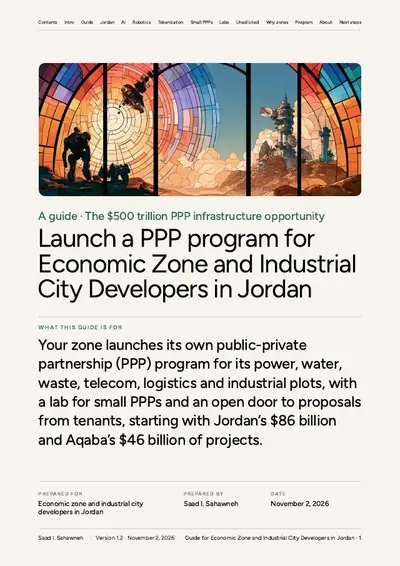
Economic zones can use the same rules. In the model the zone developers guidePDF describes, a manufacturer that needs steady power, a logistics company that sees room for a cold store or a rail siding, or a utility partner with a better treatment plant can bring its idea forward under Article 15 at its own cost. Each zone can tender a PPP research lab that runs small pilots on its own land, and similar projects proposed by tenants can be bundled into one feasibility report and one tender.

Where should an organization in Jordan start with the PPP law?
An organization in Jordan can start with the six first steps every guide shares: a mandate, a team, a map of the pipeline, its own offer, partners and a first pilot. Under the PPP law, that first pilot can be a direct proposal under Article 15 or a small-scale PPP below $14.1 million.
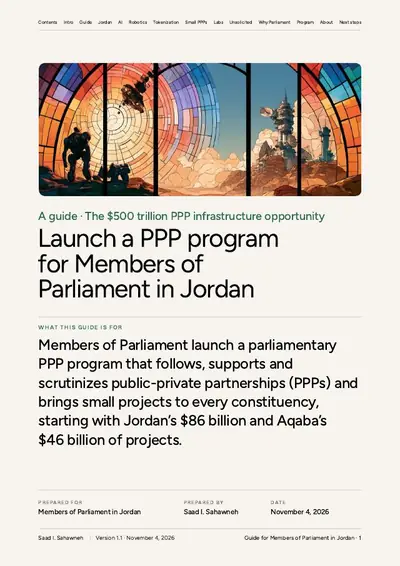
The guides also look ahead. The parliament guidePDF proposes a group of members that reviews how PPP Law No. 19 of 2023 and PPP Regulation No. 9 of 2024 work in practice and prepares the amendments that AI, robotics, tokenized finance and small-scale PPPs will need. The summary of all 76 guides brings the method together in one document, and the Vision page explains how AI, robotics and tokenization will change the assets these contracts cover.
Free PDF guides
Download the guides in this post
- Ministries and Public AuthoritiesPDFDownload
Public sector
- State-Owned Utilities and CompaniesPDFDownload
Public sector
- Law FirmsPDFDownload
Advisors and professional bodies
- AqabaPDFDownload
Public sector
- Economic Zone and Industrial City DevelopersPDFDownload
Developers and builders
- Members of ParliamentPDFDownload
National leadership