
What this organization guide is for
Your company launches a PPP program to develop defense factories and test ranges as public-private partnership (PPP) projects and to protect and inspect public infrastructure with autonomous systems.
The case
Defense factories are long-term assets, and infrastructure needs protecting
Defense equipment has long been designed to a government requirement and built in small numbers over many years. A new generation of companies invests its own capital, builds autonomous systems around software and produces them at scale in modern factories. Those factories, the ranges that test their products and the power plants, ports and water systems that need protecting are long-term assets, and PPPs can deliver them. This guide invites defense manufacturers in Jordan to launch a PPP program, starting with the projects at home.
The guide
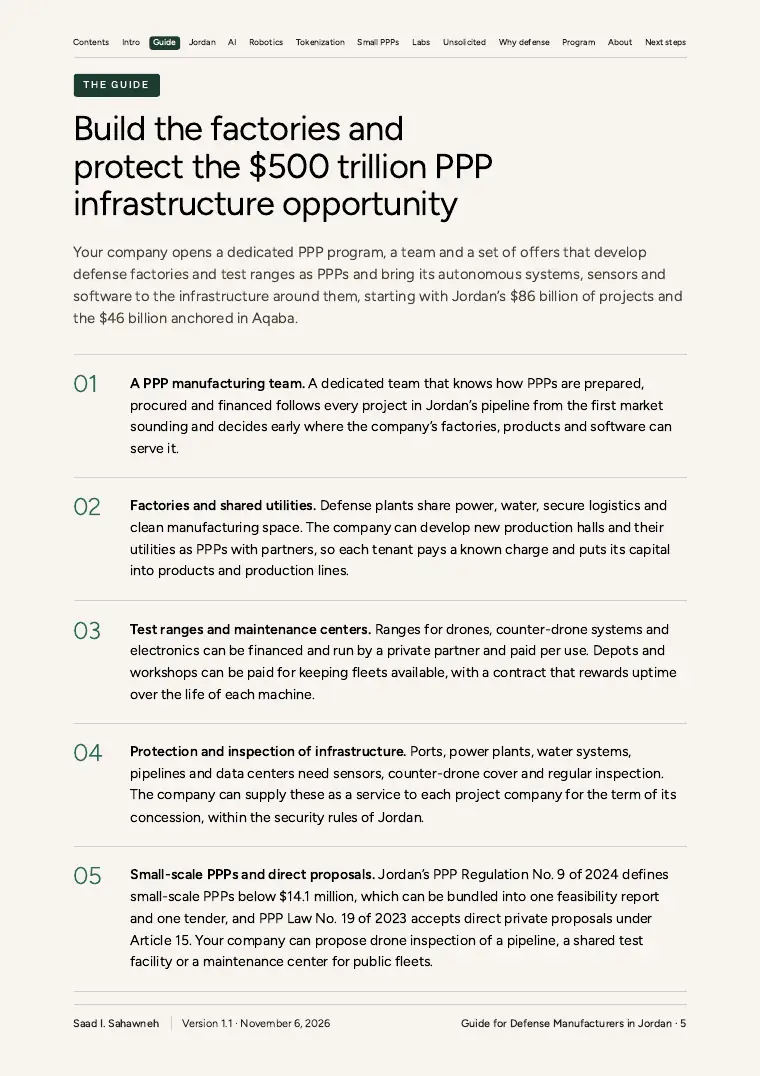
Build the factories and protect the $500 trillion PPP infrastructure opportunity
Your company opens a dedicated PPP program, a team and a set of offers that develop defense factories and test ranges as PPPs and bring its autonomous systems, sensors and software to the infrastructure around them, starting with Jordan’s $86 billion of projects and the $46 billion anchored in Aqaba.
01
A PPP manufacturing team
A dedicated team that knows how PPPs are prepared, procured and financed follows every project in Jordan’s pipeline from the first market sounding and decides early where the company’s factories, products and software can serve it.
02
Factories and shared utilities
Defense plants share power, water, secure logistics and clean manufacturing space. The company can develop new production halls and their utilities as PPPs with partners, so each tenant pays a known charge and puts its capital into products and production lines.
03
Test ranges and maintenance centers
Ranges for drones, counter-drone systems and electronics can be financed and run by a private partner and paid per use. Depots and workshops can be paid for keeping fleets available, with a contract that rewards uptime over the life of each machine.
04
Protection and inspection of infrastructure
Ports, power plants, water systems, pipelines and data centers need sensors, counter-drone cover and regular inspection. The company can supply these as a service to each project company for the term of its concession, within the security rules of Jordan.
05
Small-scale PPPs and direct proposals
Jordan’s PPP Regulation No. 9 of 2024 defines small-scale PPPs below $14.1 million, which can be bundled into one feasibility report and one tender, and PPP Law No. 19 of 2023 accepts direct private proposals under Article 15. Your company can propose drone inspection of a pipeline, a shared test facility or a maintenance center for public fleets.
Why defense manufacturers
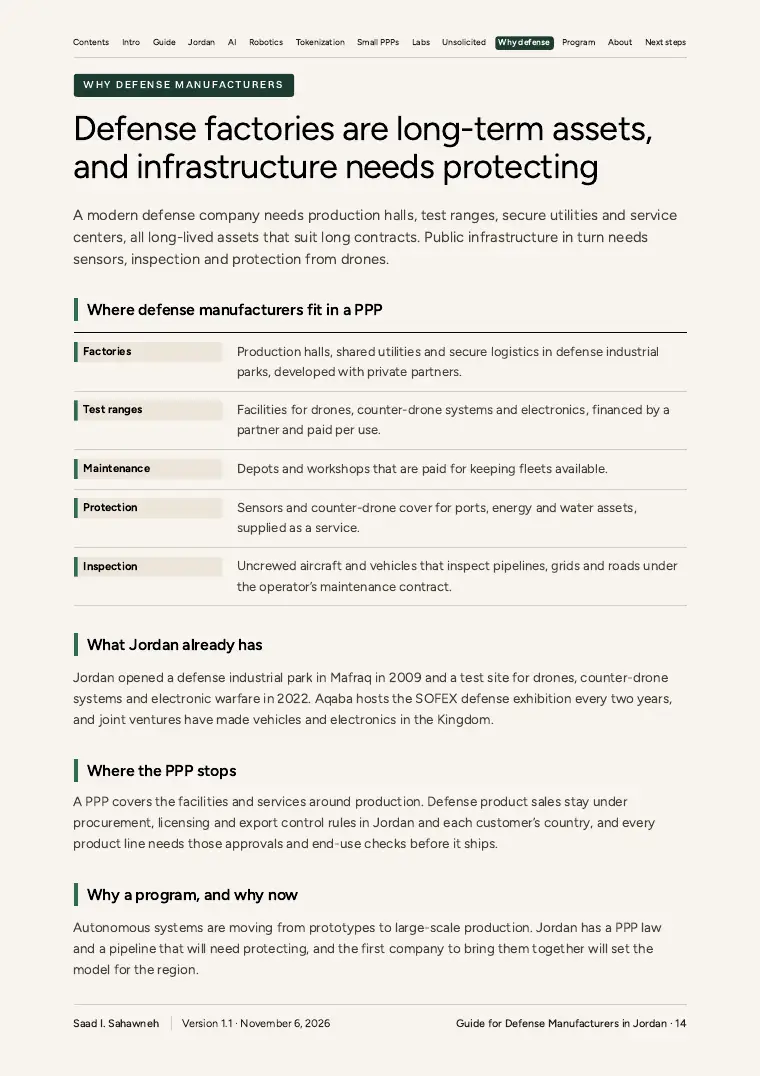
Defense factories are long-term assets, and infrastructure needs protecting
A modern defense company needs production halls, test ranges, secure utilities and service centers, all long-lived assets that suit long contracts. Public infrastructure in turn needs sensors, inspection and protection from drones.
Where defense manufacturers fit in a PPP
- Factories
- Production halls, shared utilities and secure logistics in defense industrial parks, developed with private partners.
- Test ranges
- Facilities for drones, counter-drone systems and electronics, financed by a partner and paid per use.
- Maintenance
- Depots and workshops that are paid for keeping fleets available.
- Protection
- Sensors and counter-drone cover for ports, energy and water assets, supplied as a service.
- Inspection
- Uncrewed aircraft and vehicles that inspect pipelines, grids and roads under the operator’s maintenance contract.
What Jordan already has
Jordan opened a defense industrial park in Mafraq in 2009 and a test site for drones, counter-drone systems and electronic warfare in 2022. Aqaba hosts the SOFEX defense exhibition every two years, and joint ventures have made vehicles and electronics in the Kingdom.
Where the PPP stops
A PPP covers the facilities and services around production. Defense product sales stay under procurement, licensing and export control rules in Jordan and each customer’s country, and every product line needs those approvals and end-use checks before it ships.
Why a program, and why now
Autonomous systems are moving from prototypes to large-scale production. Jordan has a PPP law and a pipeline that will need protecting, and the first company to bring them together will set the model for the region.

Futureproofing
Futureproof Defense Manufacturers in Jordan for the infrastructure singularity
This free 18-page guide shows how, with small PPPs in parallel, PPP research labs, artificial intelligence, robotics, tokenization and six first steps.
Jordan and Aqaba
An $86 billion pipeline to start with
Many of them will need protection, inspection and machines that keep working in remote places, and a growing industrial base at home can supply them. A Jordanian manufacturer that delivers one factory, range or protection contract at home can carry the same model to partners across the region.
- $86B
- of PPP and infrastructure projects in development in Jordan
- $46B
- of them anchored in Aqaba

Artificial intelligence
AI is the core of a modern defense product. It lets autonomous systems navigate, sense and report with less human workload, and it lets engineers test new designs in simulation before a prototype is built. On a PPP, the same software can read sensor feeds across a port or a power plant, flag faults and plan the upkeep of a fleet. Human control and clear accountability belong in every design from its first day.

Robotics
Robotics changes both the product and the factory. Uncrewed aircraft and ground vehicles can inspect pipelines, tanks, roofs and perimeters at lower risk to people, and robotic welding, assembly and testing let a plant build in larger numbers to the same standard every time. A manufacturer that makes machines this way can train young Jordanian engineers and technicians to build, run and repair them.

Tokenization
A defense industrial park earns rent and utility charges from its tenants for decades, and a test range earns fees from every user. A manufacturer can offer tokenized stakes in those civil assets to many investors and pay holders from those revenues as they arrive. Stakes stay limited to buildings and utilities, with investors screened under the rules that apply to the sector.

Small PPPs and research labs
Small PPPs let a manufacturer prove a civil service at low cost. It can host a PPP research lab that trials drone inspection, autonomous maintenance and sensor networks on one pipeline or water plant, publish the results and carry the pilots that work to every site.

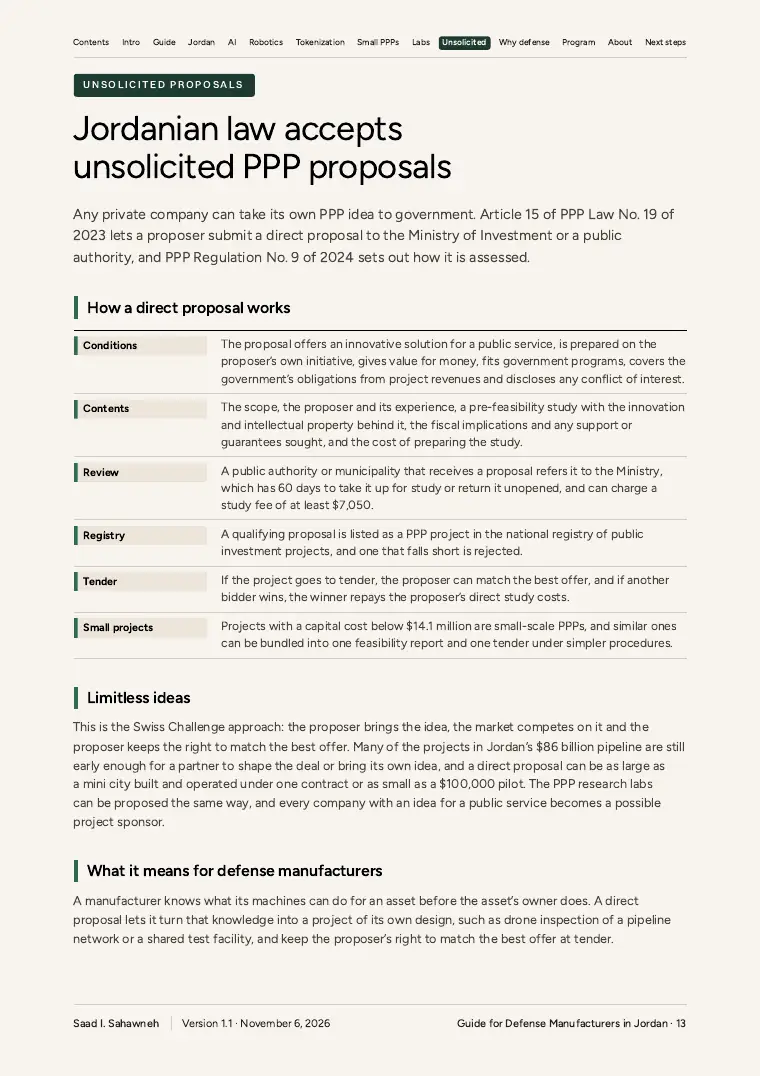
Unsolicited proposals
A manufacturer knows what its machines can do for an asset before the asset’s owner does. A direct proposal lets it turn that knowledge into a project of its own design, such as drone inspection of a pipeline network or a shared test facility, and keep the proposer’s right to match the best offer at tender.
The program
How the program could work
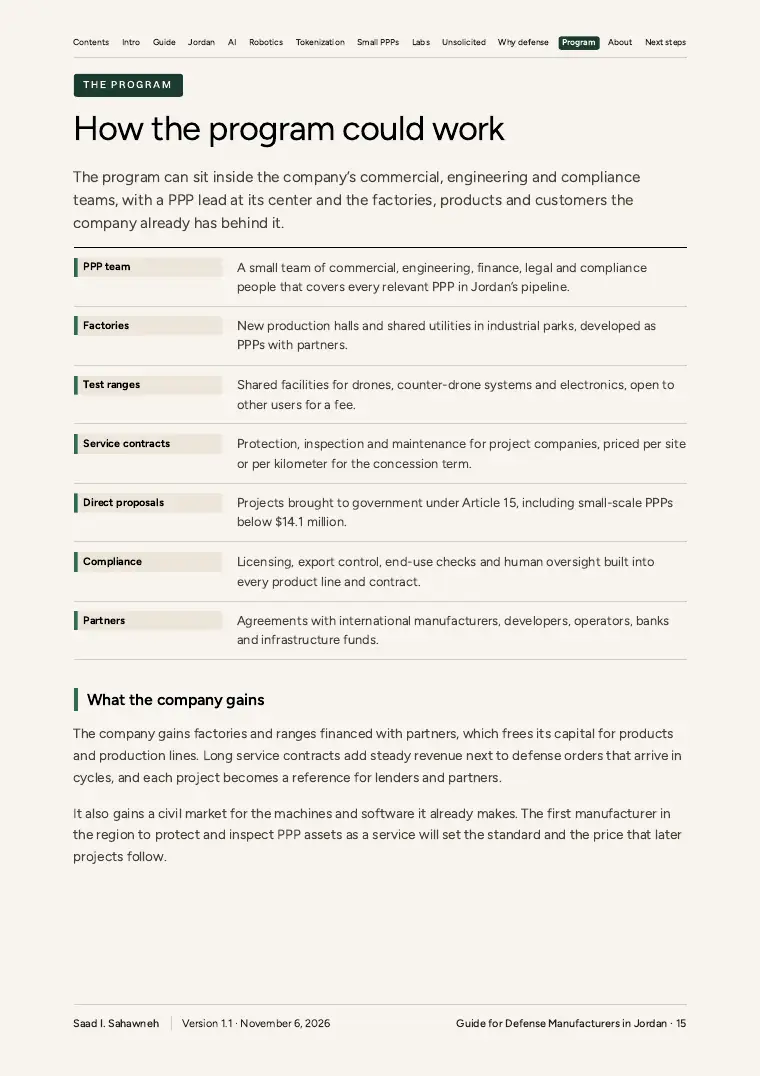
The program can sit inside the company’s commercial, engineering and compliance teams, with a PPP lead at its center and the factories, products and customers the company already has behind it.
- PPP team
- A small team of commercial, engineering, finance, legal and compliance people that covers every relevant PPP in Jordan’s pipeline.
- Factories
- New production halls and shared utilities in industrial parks, developed as PPPs with partners.
- Test ranges
- Shared facilities for drones, counter-drone systems and electronics, open to other users for a fee.
- Service contracts
- Protection, inspection and maintenance for project companies, priced per site or per kilometer for the concession term.
- Direct proposals
- Projects brought to government under Article 15, including small-scale PPPs below $14.1 million.
- Compliance
- Licensing, export control, end-use checks and human oversight built into every product line and contract.
- Partners
- Agreements with international manufacturers, developers, operators, banks and infrastructure funds.
What the company gains
The company gains factories and ranges financed with partners, which frees its capital for products and production lines. Long service contracts add steady revenue next to defense orders that arrive in cycles, and each project becomes a reference for lenders and partners.
It also gains a civil market for the machines and software it already makes. The first manufacturer in the region to protect and inspect PPP assets as a service will set the standard and the price that later projects follow.

Next steps
How a defense manufacturer can start
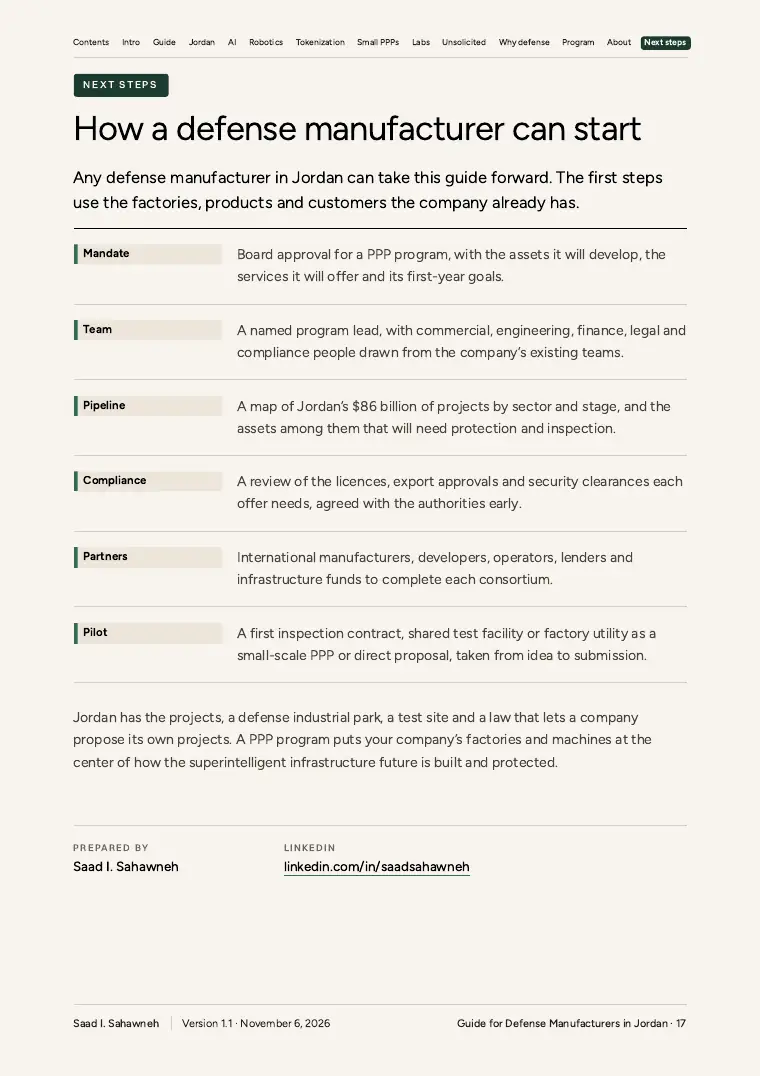
Any defense manufacturer in Jordan can take this guide forward. The first steps use the factories, products and customers the company already has.
01
Mandate
Board approval for a PPP program, with the assets it will develop, the services it will offer and its first-year goals.
02
Team
A named program lead, with commercial, engineering, finance, legal and compliance people drawn from the company’s existing teams.
03
Pipeline
A map of Jordan’s $86 billion of projects by sector and stage, and the assets among them that will need protection and inspection.
04
Compliance
A review of the licences, export approvals and security clearances each offer needs, agreed with the authorities early.
05
Partners
International manufacturers, developers, operators, lenders and infrastructure funds to complete each consortium.
06
Pilot
A first inspection contract, shared test facility or factory utility as a small-scale PPP or direct proposal, taken from idea to submission.
Jordan has the projects, a defense industrial park, a test site and a law that lets a company propose its own projects. A PPP program puts your company’s factories and machines at the center of how the superintelligent infrastructure future is built and protected.
The full document
Inside this guide
Eighteen pages and fourteen chapters, from the case for a PPP program to the first steps, written for defense manufacturers in Jordan.
- 18
- pages
- 14
- chapters
- 3
- technologies
- 6
- first steps
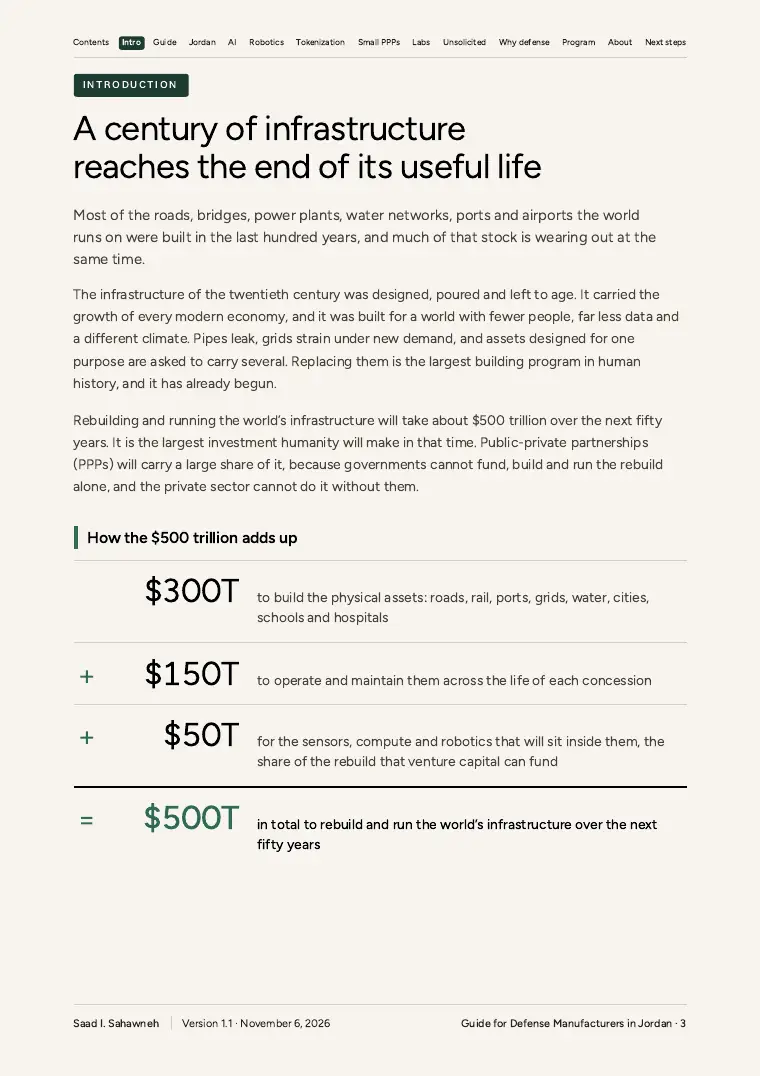
01Introduction
Why a century of infrastructure needs rebuilding, and the $500 trillion it will take.
Page 3 of 18
02The guide
Build the factories and protect the $500 trillion PPP infrastructure opportunity
Page 5 of 18
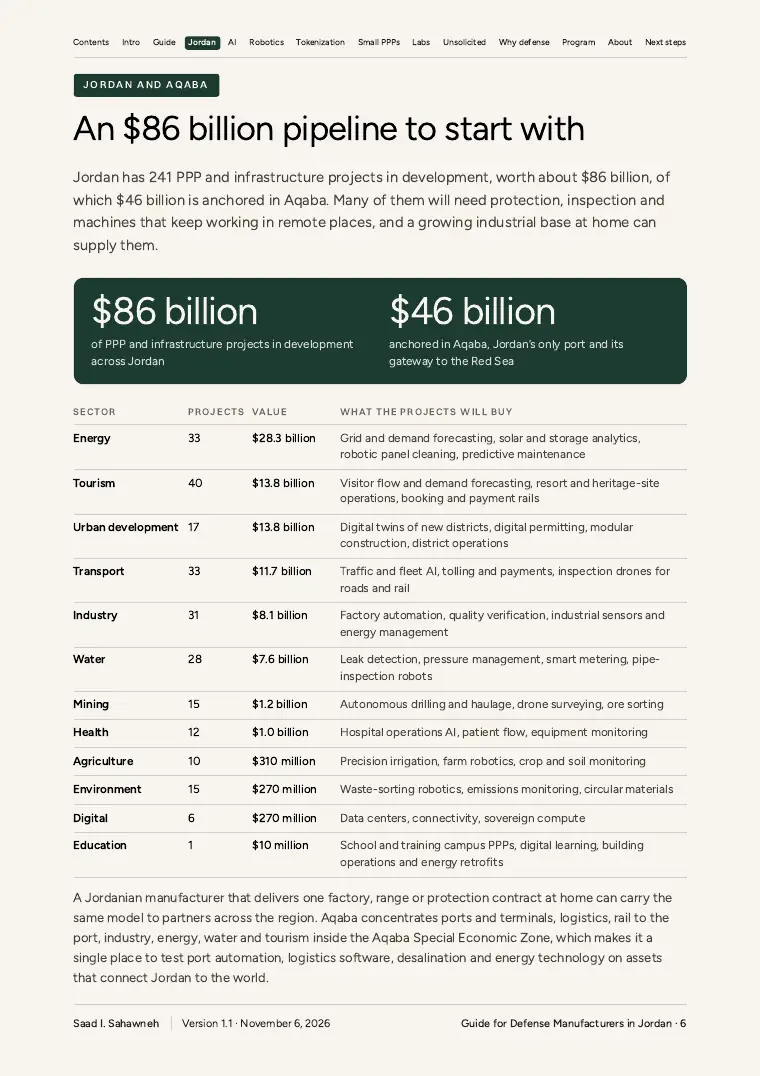
03Jordan and Aqaba
An $86 billion pipeline to start with
Page 6 of 18
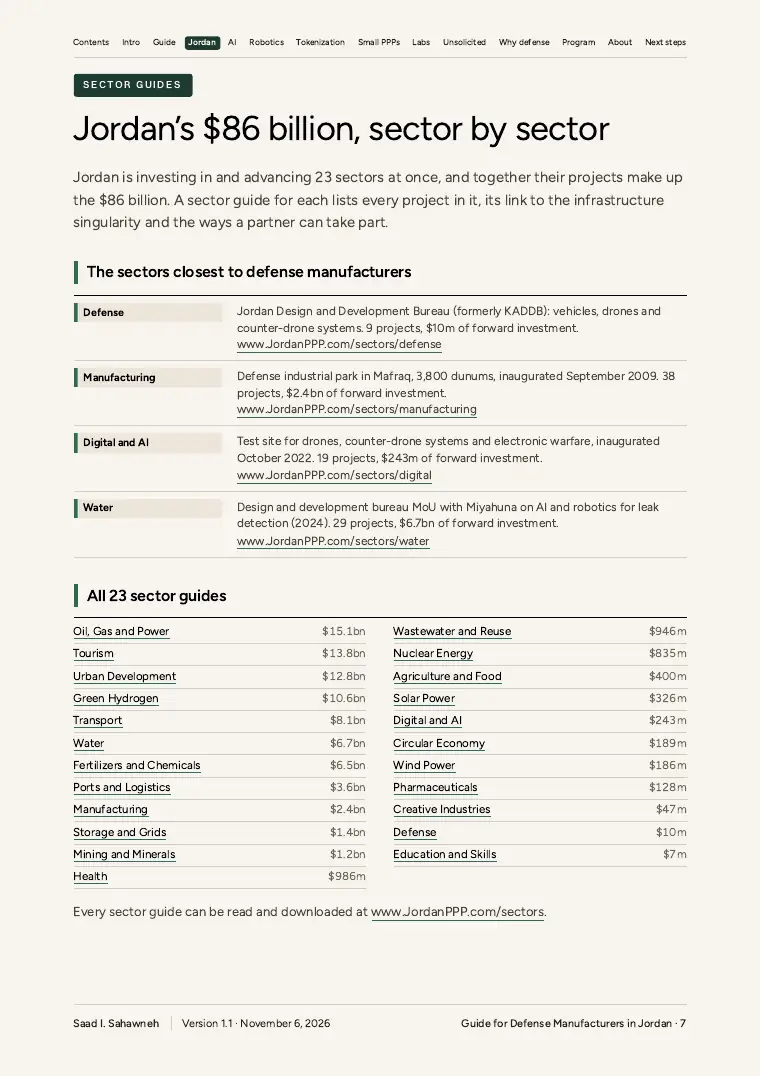
04Sector guides
The sectors closest to defense manufacturers, each with its own guide.
Page 7 of 18
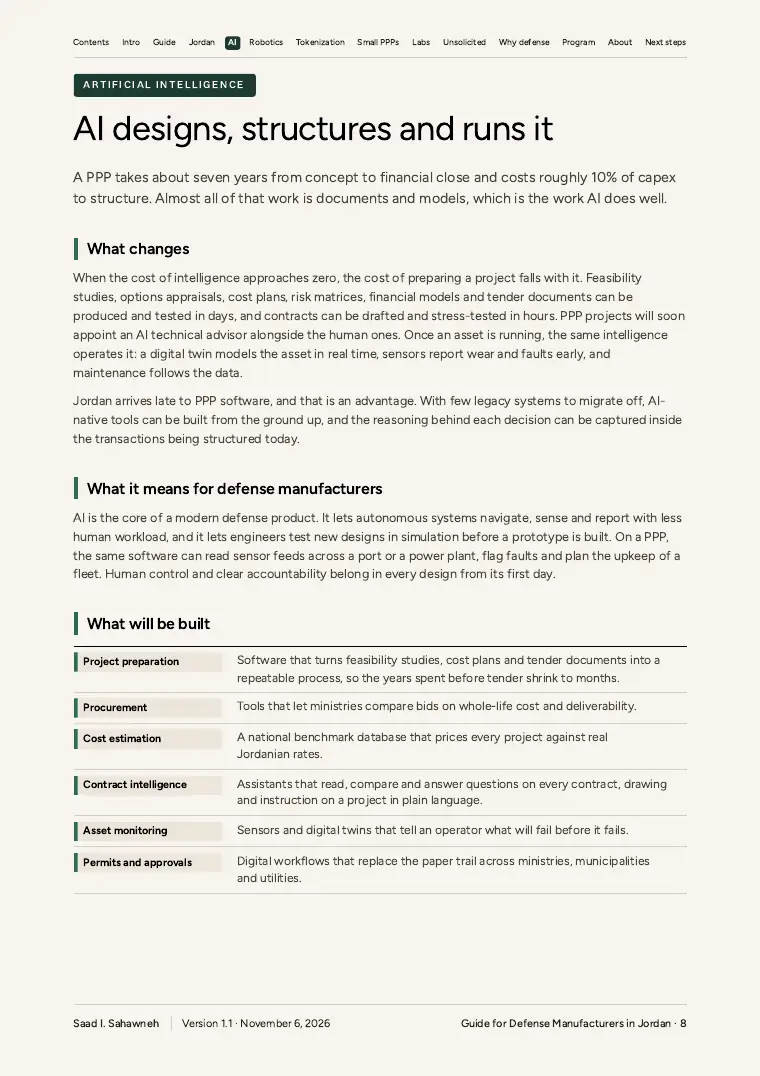
05Artificial intelligence
How AI designs, structures and runs PPP projects, and what it means for defense manufacturers.
Page 8 of 18
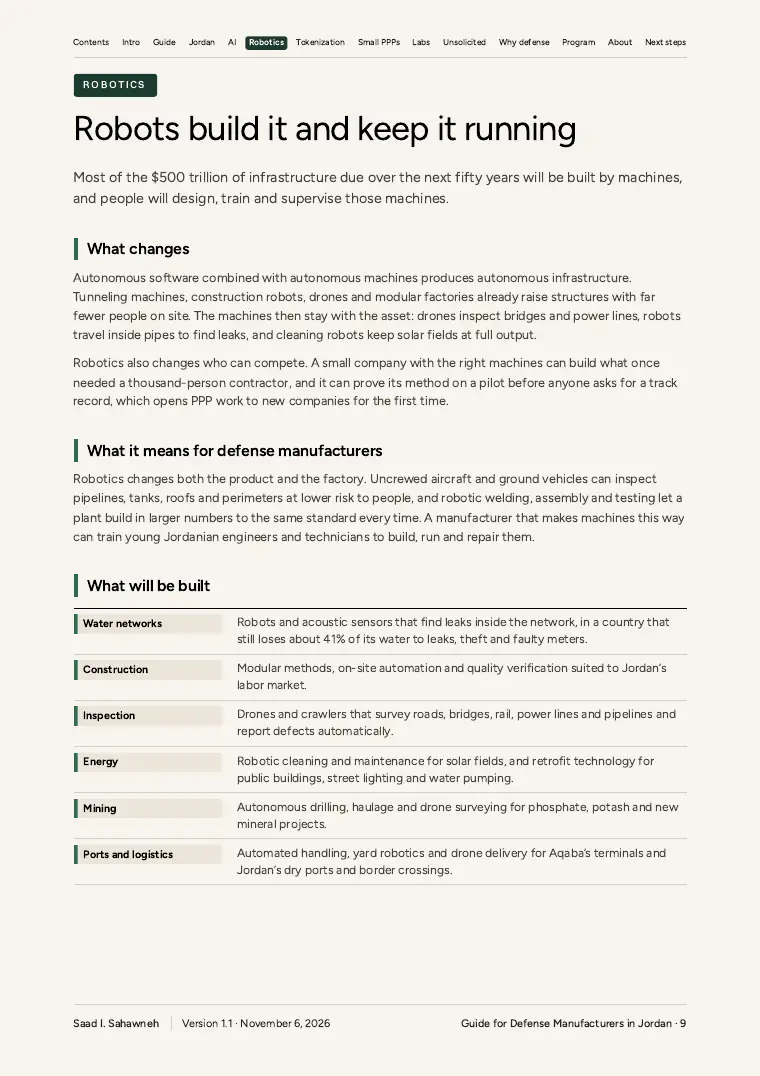
06Robotics
How robots build infrastructure and keep it running, and what that means for defense manufacturers.
Page 9 of 18
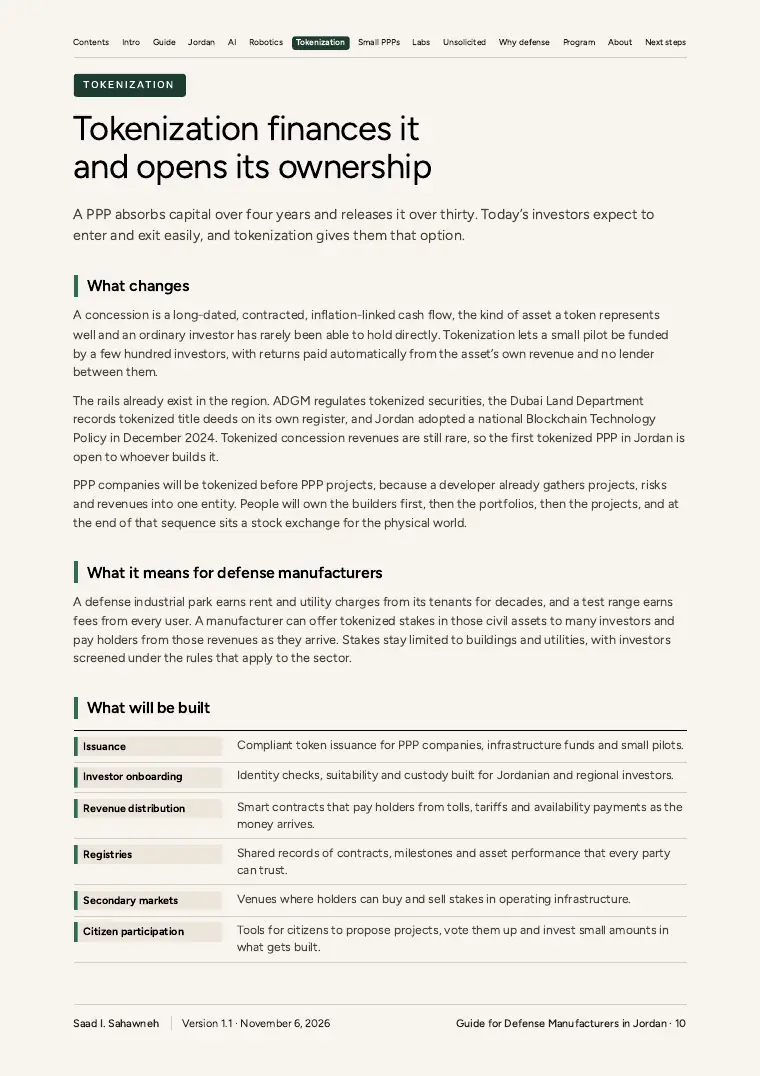
07Tokenization
How tokenization funds projects from their own revenue, and the role it opens for defense manufacturers.
Page 10 of 18
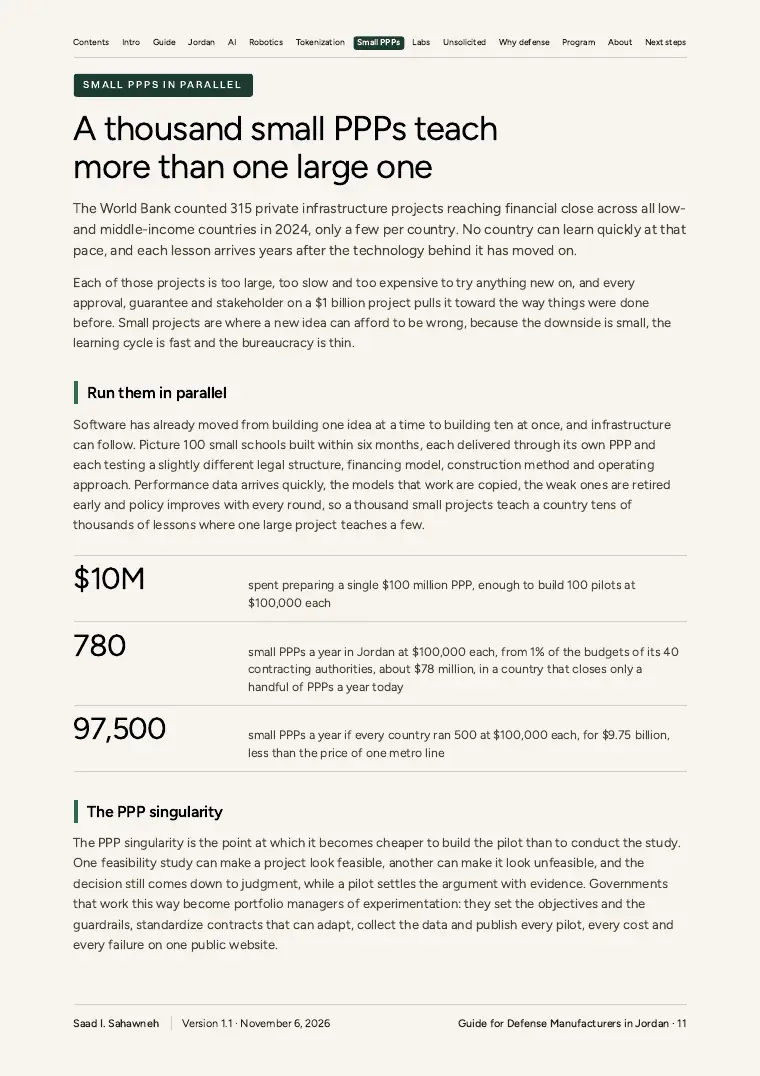
08Small PPPs in parallel
Why many small PPPs teach a country faster than a few large ones.
Page 11 of 18
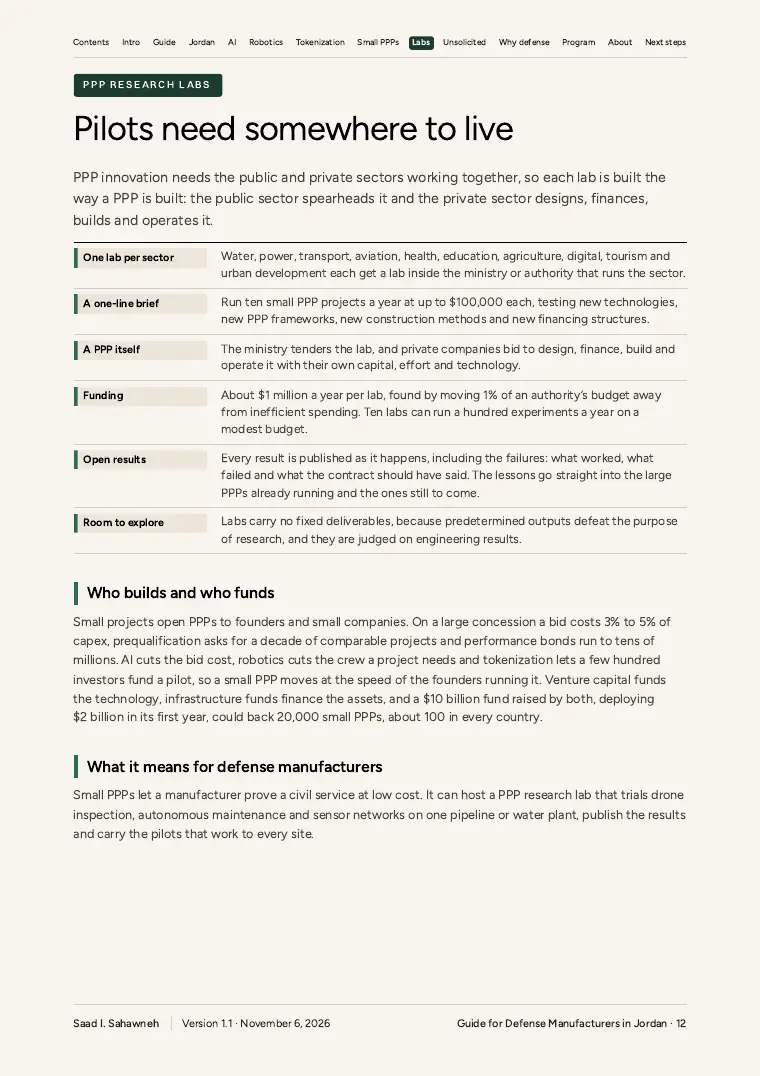
09PPP research labs
A lab in each sector, running ten small PPP projects a year.
Page 12 of 18
10Unsolicited proposals
How Jordan’s PPP law accepts direct proposals from private companies.
Page 13 of 18
11Why defense manufacturers
Defense factories are long-term assets, and infrastructure needs protecting
Page 14 of 18
12The program
The program can sit inside the company’s commercial, engineering and compliance teams, with a PPP lead at its center and the factories, products and customers the company already has behind it.
Page 15 of 18
13About
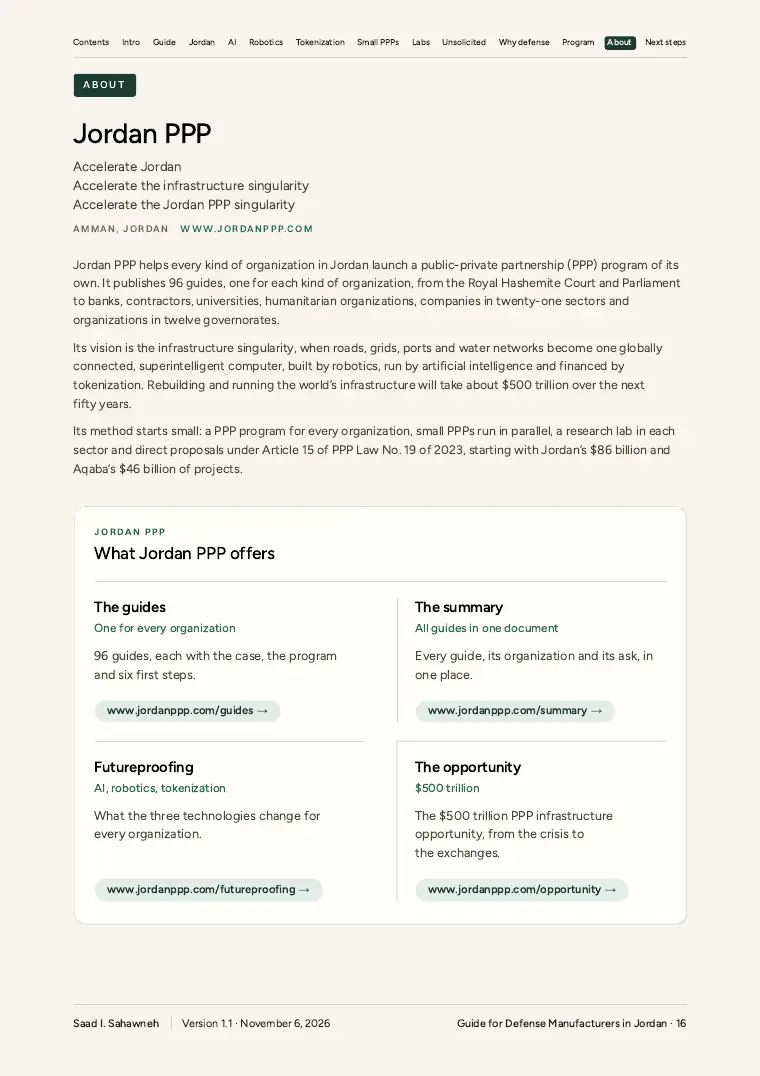
About Jordan PPP and what it offers.
Page 16 of 18
14Next steps
How a defense manufacturer can start: six first steps.
Page 17 of 18
Questions
Questions about the organization guide for Defense Manufacturers in Jordan
- What does the organization guide for Defense Manufacturers in Jordan propose?
- Your company launches a PPP program to develop defense factories and test ranges as public-private partnership (PPP) projects and to protect and inspect public infrastructure with autonomous systems.
- Why should defense manufacturers in Jordan launch a PPP program?
- Defense factories are long-term assets, and infrastructure needs protecting. A modern defense company needs production halls, test ranges, secure utilities and service centers, all long-lived assets that suit long contracts. Public infrastructure in turn needs sensors, inspection and protection from drones.
- Which PPP projects can defense manufacturers in Jordan take part in?
- Jordan has about $86 billion of PPP and infrastructure projects in development, $46 billion of them anchored in Aqaba. Many of them will need protection, inspection and machines that keep working in remote places, and a growing industrial base at home can supply them. A Jordanian manufacturer that delivers one factory, range or protection contract at home can carry the same model to partners across the region.
- How can defense manufacturers in Jordan start a PPP program?
- Any defense manufacturer in Jordan can take this guide forward. The first steps use the factories, products and customers the company already has. The organization guide sets out six first steps: mandate, team, pipeline, compliance, partners and pilot.
- What does a PPP program give defense manufacturers in Jordan?
- The company gains factories and ranges financed with partners, which frees its capital for products and production lines. Long service contracts add steady revenue next to defense orders that arrive in cycles, and each project becomes a reference for lenders and partners.
- Is the organization guide for Defense Manufacturers in Jordan free?
- Yes. It is free to read on this page and free to download as an 18-page PDF, with the case for a PPP program, Jordan’s pipeline, the role of AI, robotics and tokenization, the program and six first steps.
Sector guides
The sectors closest to defense manufacturers
Jordan’s $86 billion is spread across 23 sectors. Each sector guide lists every project in it and shows how to take part.
- Defense$10mJordan Design and Development Bureau (formerly KADDB): vehicles, drones and counter-drone systems9 projects
- Manufacturing$2.4bnDefense industrial park in Mafraq, 3,800 dunums, inaugurated September 200938 projects
- Digital and AI$243mTest site for drones, counter-drone systems and electronic warfare, inaugurated October 202219 projects
- Water$6.7bnDesign and development bureau MoU with Miyahuna on AI and robotics for leak detection (2024)29 projects
Guide 82 of 96
Browse all 96 organization guides