· 5 min read
Every part of the world’s biggest $500 trillion computer
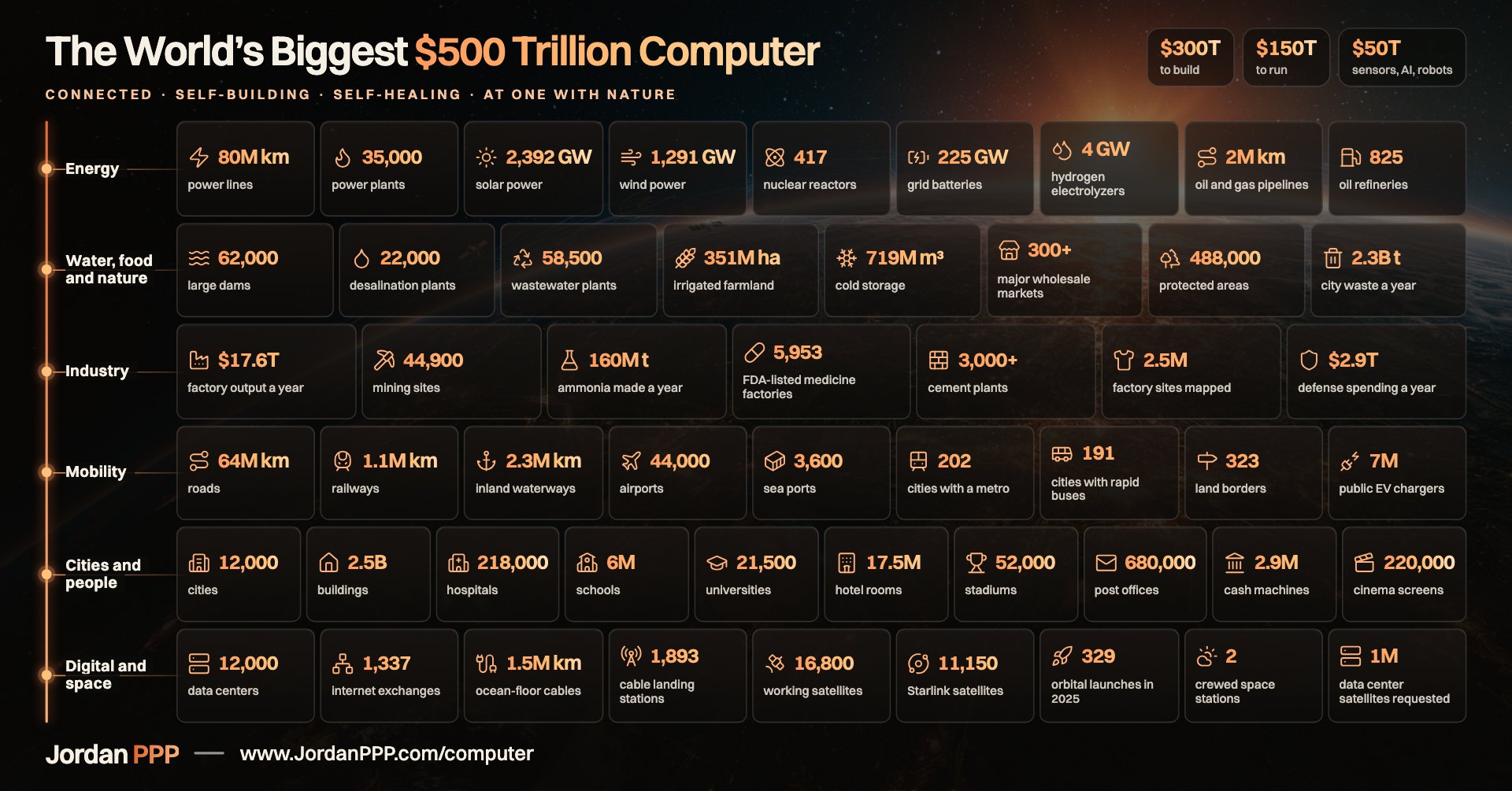
A world figure for every part of the machine: power lines, dams, factories, roads, schools, hospitals, data centers and satellites, laid out like the board inside a computer.
How big is the world’s biggest $500 trillion computer? We tried to count it. The graphic below lists 52 kinds of infrastructure, from power lines and dams to schools, hospitals and satellites, and gives a world figure for each one. Together they make up the machine that every road, pipe, cable and satellite on Earth is slowly joining.
Why count it at all
Running a machine starts with knowing its parts. A water company that knows every pipe it owns can find a leak in hours. A country that knows where every school, clinic and substation stands can plan where the next one should go. Counting is the first step toward the sensors, maps and software that will let infrastructure watch its own condition and plan its own repairs.
This count also shows the size of the job ahead. Rebuilding and running all of it will take about $500 trillion over the next fifty years: $300 trillion to build, $150 trillion to run and maintain, and $50 trillion for the sensors, AI and robots that turn concrete and steel into a computer. Those three figures sit at the top of the graphic.
Read it like a circuit board
The graphic is laid out like the board inside a laptop. The orange line on the left works like the main line that carries power and data. Six lanes branch off it, one for each family of infrastructure, and every tile is one part with its world figure. The lanes follow the sector guides on Jordan PPP, so every tile matches a part of Jordan’s own pipeline of projects. The same board, with a source for every figure, is on the computer page.
Energy: the power supply
Nothing in the machine works without power. The world has about 80 million kilometers of power lines, according to the International Energy Agency, and about 35,000 power plants in the World Resources Institute’s database. By the end of 2025 the world had 2,392 gigawatts of solar power and 1,291 gigawatts of wind power, according to IRENA, more than any other renewable source. There are 417 nuclear reactors running, according to the IAEA, about 225 gigawatts of grid batteries, 4 gigawatts of machines that make hydrogen from water, 2 million kilometers of oil and gas pipelines and 825 oil refineries.
Water, food and nature
The world has about 62,000 large dams and about 22,000 plants that turn seawater into drinking water for more than 300 million people, according to the International Desalination and Reuse Association. About 58,500 plants clean wastewater, according to the HydroWASTE map. Farmers irrigate 351 million hectares, about a fifth of all cropland, according to the FAO, and 719 million cubic meters of cold stores keep food fresh on its way to the table.
Nature has a lane of its own. There are about 488,000 protected areas covering 17.5% of the world’s land and almost 10% of its oceans, according to Protected Planet. On the other side of the ledger, cities throw away about 2.3 billion tonnes of waste a year, and that figure is on track to reach 3.8 billion tonnes by 2050. A computer that works in harmony with nature has to shrink that number.
Industry: the factories that make the parts
Factories around the world added $17.6 trillion of value in 2025, according to the World Bank. Satellites have mapped about 44,900 mining sites, recorded in a global dataset published in Scientific Data. The world makes about 160 million tonnes of ammonia a year, most of it for fertilizer, and more than 3,000 cement plants turn out the main ingredient of concrete. There are 5,953 medicine factories on the US Food and Drug Administration’s list, and the Open Supply Hub has mapped about 2.5 million factory sites. Defense is part of the picture too: the world spent $2.9 trillion on its militaries in 2025, according to SIPRI.
Mobility: the circuits
Roads, rails and waterways are the circuits that carry people and goods. The world has about 64 million kilometers of roads, 1.1 million kilometers of railways and 2.3 million kilometers of rivers and canals that ships can use. It has about 44,000 airports and 3,600 sea ports. 202 cities run a metro, according to UITP, and 191 cities run rapid bus lines with their own lanes. The world’s countries share 323 land borders, and drivers can plug into more than 7 million public chargers for electric cars, 1.8 million of them added in 2025 alone, according to the IEA.
Cities and people: what it is all for
Every other lane exists to serve this one. There are about 12,000 cities with 50,000 or more people, according to the United Nations, and Overture Maps has mapped 2.5 billion buildings. The world has about 6 million schools, and nearly half of them still have no internet connection, according to the UN’s Giga project. It has about 21,500 universities, about 218,000 hospitals, 17.5 million hotel rooms, 52,000 stadiums, 680,000 post offices, 2.9 million cash machines and 220,000 cinema screens.
Digital and space: the network and the processors
The digital lane holds the parts that think and talk. About 12,000 data centers act as the machine’s processors. They connect through 1,337 internet exchanges, listed on PeeringDB, and 1.5 million kilometers of cable on the ocean floor, which come ashore at 1,893 landing stations, according to TeleGeography.
Above them, about 16,800 working satellites circle the Earth, according to the KeepTrack catalog, and about 11,150 of them belong to Starlink. Rockets were launched toward orbit a record 329 times in 2025, according to Jonathan McDowell, and two crewed space stations are in orbit. SpaceX has also asked permission to launch up to one million satellites for data centers in space. The story of that next step is in Space: the next PPP frontier.
What we could not count
Some parts of the machine have no reliable world count yet. Nobody has counted the world’s care homes, cell towers, courts, bridges or tunnels in one place. Some figures are also old. The last world totals for roads, railways and airports come from the CIA World Factbook, which closed in February 2026, and they date from 2010 to 2013. Filling these gaps is part of the work ahead. Sensors, satellite maps and shared records will give every part of the machine a count that updates itself.
Where Jordan fits
Jordan has a project in almost every lane of the board. The Aqaba-Amman water project will add seawater desalination, the Al-Mujib plant will store power as water pumped up a hill, a new railway will carry phosphate and potash to the port of Aqaba, and a National Broadband Network will carry fiber across the country. Jordan launched its first satellite in 2018 and signed the Artemis Accords in April 2026.
The country has $86 billion of PPP and infrastructure projects in development, including $46 billion in Aqaba. Article 15 of its PPP Law lets any private company take its own PPP idea to the Ministry of Investment or a public authority. The mission of Jordan PPP is to build the most advanced PPP system in the world, and www.JordanPPP.com offers 96 organization guides and 23 sector guides for free. To take your team through every part of the machine, book a presentation.