· 8 min read
How to futureproof your organization in Jordan and Aqaba for the infrastructure singularity
The moves that prepare any public or private organization in Jordan and Aqaba for the infrastructure singularity, from a first mandate to small tests of AI, robotics and tokenization.
An organization in Jordan futureproofs itself by learning by building now: it launches a PPP program of its own, runs small PPPs in parallel, opens a research lab in its sector, collects data from every asset and pilot, and tests AI, robotics and tokenization on small projects before they reach its largest ones. These moves apply to any public or private organization, and they start with Jordan’s $86 billion of PPP and infrastructure projects in development, $46 billion of them anchored in Aqaba. This post takes each move in turn, drawing on the futureproofing page and the 96 free organization guides.
What does it mean to futureproof an organization in Jordan?
To futureproof an organization in Jordan means preparing it for the infrastructure singularity, the point where the built world starts improving itself faster than anyone can direct it. The singularity will change how every organization plans, builds, runs and finances what it owns, and those that start learning by building now will be ready to lead it.
$500T
to rebuild and run the world’s infrastructure over the next fifty years, with $50 trillion of it for the sensors, compute and robotics inside the assets
Three technologies bring that point closer. Artificial intelligence designs and runs the assets, robotics builds and maintains them, and tokenization finances them and opens their ownership to everyone. The Vision page sets out the full picture.
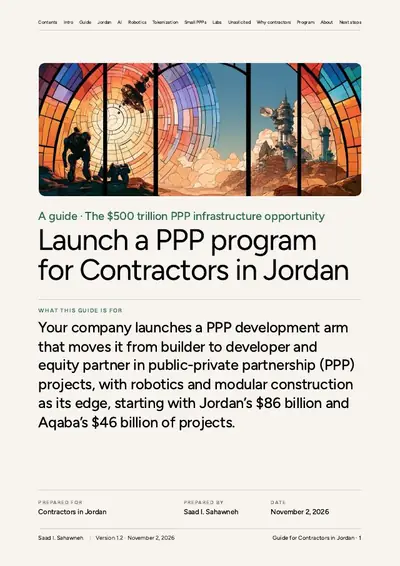
The change looks different from each chair. A contractor usually hands the asset over at completion while the sponsors keep the decades of revenue that follow, so the contractors guidePDF proposes a development arm. Municipalities run street lights, markets, bus stations and parking on tight budgets, and the municipalities guidePDF shows how small PPPs can improve each one. Law firms will see data, machines and digital assets enter the contracts they draft. The futureproofing page sets out what the next fifty years mean for each kind of organization.
Why should organizations in Jordan and Aqaba start now?
Organizations in Jordan and Aqaba should start now because the pipeline is large and early. Jordan has about $86 billion of projects in development, and the consortiums for Aqaba’s largest projects are forming now, so the organizations that join the first projects will help set the standards the rest follow.
$46B
of Jordan’s $86 billion of PPP and infrastructure projects are anchored in Aqaba, and most of it will need local partners to prepare, build and run it
The legal route is already open. PPP Law No. 19 of 2023 took effect on November 13, 2023, PPP Regulation No. 9 of 2024 followed it, and the PPP Unit sits at the Ministry of Investment. Article 15 of the law lets any private company take its own PPP idea to the Ministry of Investment or a public authority, and the unsolicited proposals page sets out that route. A ministry that publishes the needs it wants solved receives proposals aimed at them.
How does an organization in Jordan launch a PPP program of its own?
An organization in Jordan launches a PPP program of its own with six first steps: a mandate, a team, a map of the pipeline, its own offer, partners and a first pilot. The steps use the land, assets, people and partners the organization already has, and each guide adapts them to one kind of organization.
- 01Mandate. The board or management approves a PPP program, with its sectors, its role and its first-year goals.
- 02Team. A named lead draws business, technical, legal and finance people from the organization’s existing teams.
- 03Pipeline. The team maps projects by sector and stage and meets early with the authorities and developers behind them.
- 04Offer. The organization packages the land, assets, services and workforce it can bring to a consortium into one offer.
- 05Partners. Developers, contractors, operators, banks and other organizations agree to bid together.
- 06Pilot. A first consortium bid, small concession or direct proposal goes from idea to submission.
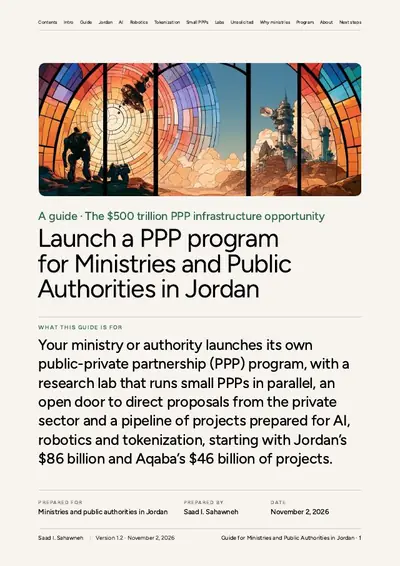
The program takes the shape of the organization. In a company it can sit inside the strategy or business development team, with a PPP lead at its center. A ministry or authority builds it around a PPP unit, with a research lab beside it, as the ministries guidePDF describes. A university opens a program of courses, research labs and partnerships with government and industry, set out in the universities guidePDF. The public sector category gathers the guides for contracting authorities and governorates.
How do small PPPs in parallel prepare an organization in Jordan?
Small PPPs in parallel prepare an organization in Jordan by letting it test many legal structures, financing models and construction methods at once. PPP Regulation No. 9 of 2024 defines small-scale PPPs below $14.1 million, and a small concession gives an organization a live asset, a reference and a place in the larger projects that follow.
The arithmetic favors the small project. A single $100 million PPP can spend $10 million on preparation, enough to build 100 pilots at $100,000 each. The World Bank counted 315 private infrastructure projects reaching financial close across all low- and middle-income countries in 2024, only a few per country, and no country learns quickly at that pace.
780
small PPPs a year in Jordan at $100,000 each, funded by 1% of the budgets of 40 contracting authorities, about $78 million
These projects move the organization toward the PPP singularity, the point at which it becomes cheaper to build the pilot than to conduct the study. The small PPPs page sets out what they offer each kind of organization.
How do a PPP research lab and pilot data futureproof an organization in Jordan?
A PPP research lab gives an organization in Jordan a steady supply of tested ideas. Each sector gets its own lab, spearheaded by the public sector and designed, financed, built and operated by the private sector, running ten small PPP projects a year at up to $100,000 each and publishing every result.
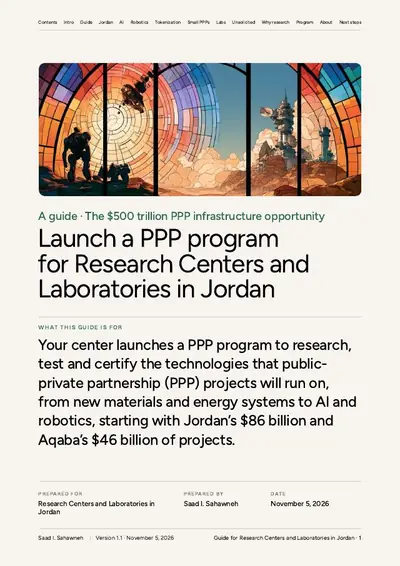
A ministry can tender the lab as a PPP, write its one-line brief, set its guardrails, collect the data from each pilot and carry what works into the large projects in the pipeline. A regional authority suits a lab because it holds land, licenses and services in one territory, as the regional authorities guidePDF explains. Other organizations take part too, and the research centers guidePDF describes a center bidding to design and operate a sector lab. Every published result, including the failures, teaches the other contracting authorities as well.
Aqaba is small enough to test a new idea quickly and busy enough to prove it.
An organization in Aqaba can host a lab, run pilots on its own land and assets and publish every result, so the pilots that work there become the models for the rest of Jordan.
Data from every pilot, gathered from its first day, is what turns those tests into an advantage. A fintech company can report each pilot’s revenue in real time, as the fintech guidePDF describes, which shows which small projects earn their keep. A credit guarantee institution can price each guarantee on live data from the projects it backs. An organization in Aqaba can use the same data to find the next project worth proposing.
How can an organization in Jordan get ready for AI, robotics and tokenization?
An organization in Jordan gets ready for AI, robotics and tokenization by testing each one on small projects before it reaches the largest ones. Each organization guide sets out what the three technologies change for its readers, and the busiest systems in Aqaba show where those first tests can begin.

Artificial intelligence. In Aqaba, AI can plan berths and yard moves, forecast truck and cargo flows and balance water and power demand across the zone. An organization there can bring those tools into every concession it joins. The AI page sets out what changes for each kind of organization.
Robotics. Automated cranes, yard vehicles, drones and inspection robots can raise the capacity of Aqaba’s terminals and keep its pipes, roads and power lines in shape, and they will need Jordanian technicians trained in Aqaba to operate and maintain them. A ministry can write drone inspection, robotic leak detection and automated maintenance records into its output specifications, so machines measure performance and report it as data. The robotics page covers the other organizations.
Tokenization. A project company can raise part of its capital from a few hundred investors and pay them from the asset’s own revenue. In Aqaba, an organization can offer tokenized stakes in a terminal, a resort utility or a water plant to local and regional investors. The tokenization page explains how the model funds small pilots.
Which guide should a leader in Jordan or Aqaba read first?
A leader in Jordan or Aqaba should read first the organization guide written for their kind of organization, then the sector guides for what it builds. Each of the 96 free guides is an 18-page PDF that ends with six first steps, starting with a mandate and a named lead.
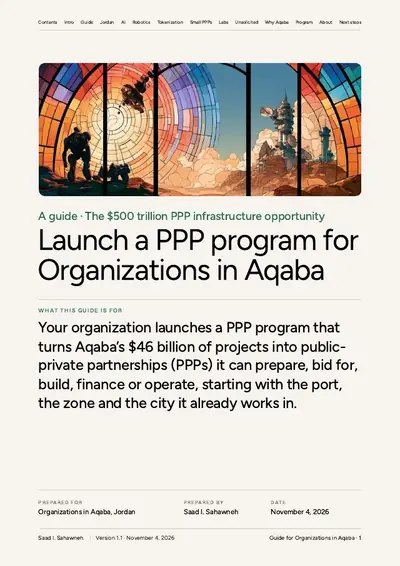
The guide for organizations in AqabaPDF suits any organization working in the port, the zone or the city. The 23 sector guides cover the sectors behind the $86 billion, and the summary of all 96 guides brings the method together in one document for a board or leadership team. Readers new to the model can begin with the starting guide.