· 8 min read
How the Royal Hashemite Court and the Prime Ministry could shape a national PPP program in Jordan
Two guides invite the Royal Hashemite Court and the Prime Ministry to consider complementary roles in a national PPP program for Jordan and Aqaba.
The guides on this site propose two complementary roles for a national PPP program in Jordan: the Royal Hashemite Court as a possible national champion that spans every sector, and the Prime Ministry as the center of government that could run a government-wide PPP acceleration program. Both are in step with the Economic Modernisation Vision and its 2033 horizon, and both start with Jordan’s $86 billion of projects and the $46 billion anchored in Aqaba. They are proposals and invitations published on this site, and neither describes a program now in place.
What is the Royal Hashemite Court PPP proposal?
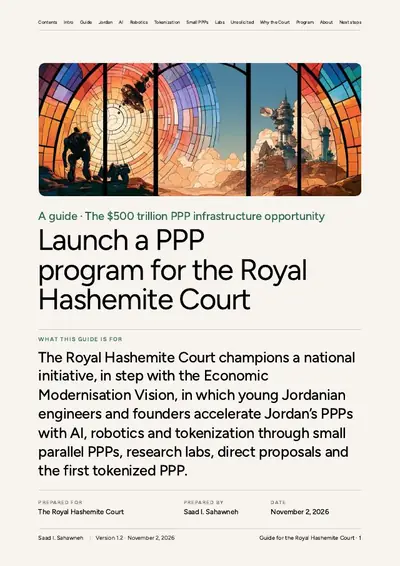
The Royal Hashemite Court guidePDF respectfully invites the Court to champion a national initiative that brings AI, robotics and tokenization into Jordan’s PPP projects. The guide proposes small parallel PPPs, PPP research labs, an open door for direct proposals, the first tokenized PPP and a visible place for young Jordanian engineers and founders.
This guide respectfully invites the Royal Hashemite Court to champion a national initiative that brings these together, starting with the projects at home.
The guide’s reasoning rests on reach. Small PPPs, research labs, direct proposals and tokenized finance reach across water, power, transport, health, education and every other sector, and they involve ministries, regulators, lenders, universities and young companies at once. In the guide’s words, an initiative of that reach benefits from a champion that stands above any single sector, with a horizon that runs to 2033 and beyond.
The guide describes five places where a national champion could fit:
- 01Direction. A clear national ambition for small PPPs, research labs, direct proposals and tokenized finance, in step with the Economic Modernisation Vision.
- 02Convening. One table for ministries, public authorities, lenders, universities, investors and the companies that bid.
- 03Continuity. A horizon long enough for pilots to run, for results to be published and for the best models to reach the large PPPs.
- 04Youth. A visible place for young Jordanian engineers and founders to build the tools, robots and companies the projects need.
- 05Partners. A clear national direction for the international lenders, investors and technology partners who look for one before they commit capital.
Young Jordanian engineers and founders could design the software, run the robots and structure the finance for these projects. The guide’s aim is that the skills and companies the initiative creates stay in Jordan and can serve the wider region.
What is the proposed Prime Ministry of Jordan PPP program?
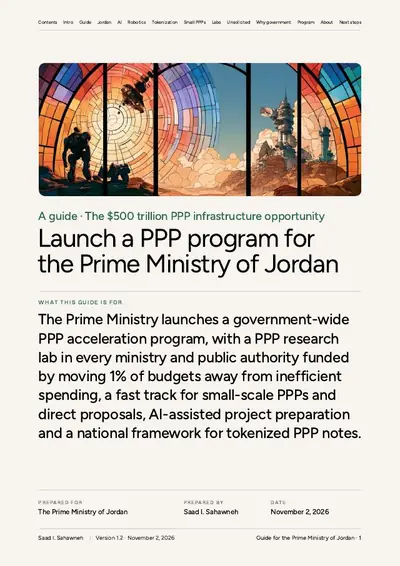
The Prime Ministry guidePDF invites the Prime Ministry of Jordan to launch a government-wide PPP acceleration program. It proposes a PPP research lab in each of the 40 contracting authorities, fast tracks for small-scale PPPs and direct proposals, AI-assisted project preparation and a national framework for tokenized PPP notes, all in one program.
The reasoning starts with how a PPP moves through government. A sector ministry defines the service, other institutions review, fund and approve the project, and public authorities permit and supervise it for decades. A program led from the center could let all of them work to one timetable, one set of standard documents and one record of results.
The guide’s funding idea is specific. Each contracting authority could tender a lab that runs ten small pilots a year, funded by moving 1% of its budget away from inefficient spending. Every pilot would publish its results, including the failures.
$78M
a year across government if 1% of budgets moved away from inefficient spending, which the guide calculates is more than enough for 40 labs and 400 pilots
How could the two roles fit together in a national PPP program in Jordan?
The two guides describe different layers of a national PPP program in Jordan. The Royal Hashemite Court could give direction, convene participants and offer continuity across every sector, while the Prime Ministry could coordinate ministries, set common standards and run the budget rule and shared record that keep delivery consistent across government.
Each guide is a separate invitation and can stand alone. Read side by side, they rest on the same foundations: PPP Law No. 19 of 2023, which took effect on November 13, 2023, PPP Regulation No. 9 of 2024, the national Blockchain Technology Policy of December 2024 and the Economic Modernisation Vision. Both guides note that the 2033 horizon leaves time for several rounds of pilots and for the best results to reach the large projects.
They also meet at the research labs and the public record. The Royal Hashemite Court guide proposes labs in the ministries and authorities that run each sector, each running ten small PPP projects a year at up to $100,000 each. The Prime Ministry guide adds a common brief, a model tender and a funding rule for those labs. Both propose one public website that publishes every pilot, every cost and every failure.

How could small PPPs and direct proposals move faster in Jordan?
In Jordan, the Prime Ministry guide proposes two fast tracks. Small-scale PPPs below $14.1 million could use standard documents and agreed timelines, and direct proposals under Article 15 of PPP Law No. 19 of 2023 could follow a clear route and timetable, guided by one public list of needs across government.
$14.1M
the line below which PPP Regulation No. 9 of 2024 defines a small-scale PPP, the size the proposed fast track would serve
Small-scale PPPs can be bundled into one feasibility report and one tender under simpler procedures. Article 15 lets a company bring its own PPP idea to government at its own cost, and the tender still tests the idea against the market.
The Royal Hashemite Court guide approaches the same two routes through visibility. A national initiative could make direct proposals widely known, especially among young founders, and publish the public services that most need new ideas. It could also give small PPPs scale, with labs in many sectors publishing their results in one place and small PPPs sized for new companies to win.
What could AI and tokenized PPP notes add to a national PPP program in Jordan?
In Jordan, the guides describe AI and tokenization as tools every ministry could share. Shared AI tools could prepare feasibility studies and tender documents for every ministry in months, while a national framework for tokenized PPP notes could let citizens and regional investors fund projects at home, paid from each asset’s own revenue.
The Royal Hashemite Court guide adds that young Jordanian engineers could build open tools on local data and local rates, and that the same tools could let the public follow each project from preparation to operation in plain language. It also proposes a first tokenized PPP on a small project with contracted revenue, funded by a few hundred investors, with every milestone recorded on a public registry.
The Prime Ministry guide describes the rules such a first issue could follow: how a project company issues notes, who may hold them, how holders are paid from the asset’s revenue and how performance is reported. Later issues could then follow the same rules. Robotics appears in both guides as well, through small pilots for leak-detection robots and road survey drones, and through standard output specifications that could ask for drone inspection and automated maintenance records.
Where does Aqaba fit in a national PPP program for Jordan?
Aqaba anchors more than half of the pipeline both guides start from. Jordan has about $86 billion of PPP and infrastructure projects in development, and about $46 billion of them are anchored in Aqaba, Jordan’s only port and its gateway to the Red Sea.
$46B
of Jordan’s $86 billion of PPP and infrastructure projects in development is anchored in Aqaba
The Royal Hashemite Court guide notes that the projects reach across energy, water, transport, tourism, industry and urban development. The Prime Ministry guide notes that they are spread across many ministries and public authorities, and that they will move fastest when those institutions work from one approach and learn from each other’s results.
The National Water Carrier shows the scale of the projects tied to Aqaba. In April 2026 the final agreement for the National Water Carrier was signed: about $4.3 billion to bring 300 million m³ of water a year from Aqaba through a 450 km pipeline. Both guides propose testing new ideas on small projects at home and carrying the results into the largest PPPs, and both place that work within the $500 trillion opportunity described on the vision page.
How could a national PPP program in Jordan start?
Each guide closes with conditional first steps for Jordan, offered should either institution wish to take them forward. They share a common shape: a mandate, a small team, a review of the $86 billion pipeline, invited partners and a first pilot taken from idea to tender, using laws, institutions and people already in place.
The Royal Hashemite Court guide adds an open call for young Jordanian engineers and founders to join the first labs and to propose the first small PPPs. The Prime Ministry guide adds a focal point in each ministry and public authority, and a first issue of tokenized PPP notes on a small project.
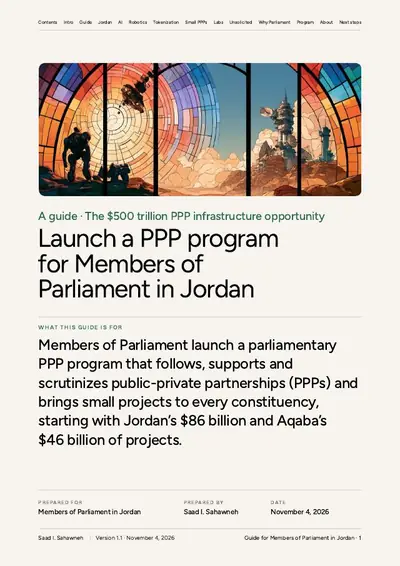
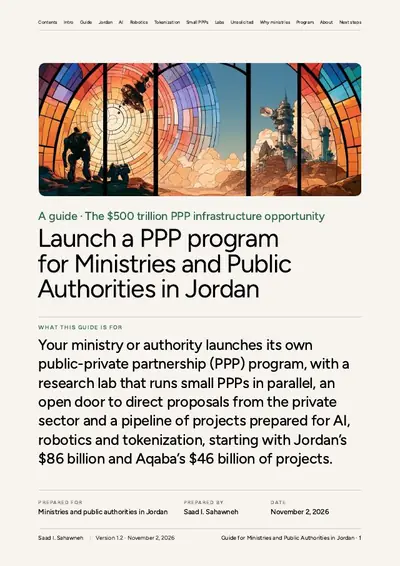
Other institutions have guides of their own. The Parliament guidePDF invites Members of Parliament in Jordan to launch a parliamentary PPP program, and the ministries guidePDF invites ministries and public authorities to launch programs of their own. The national leadership category gathers the guides for the Royal Hashemite Court, the Prime Ministry and Parliament.